
































































































































































































































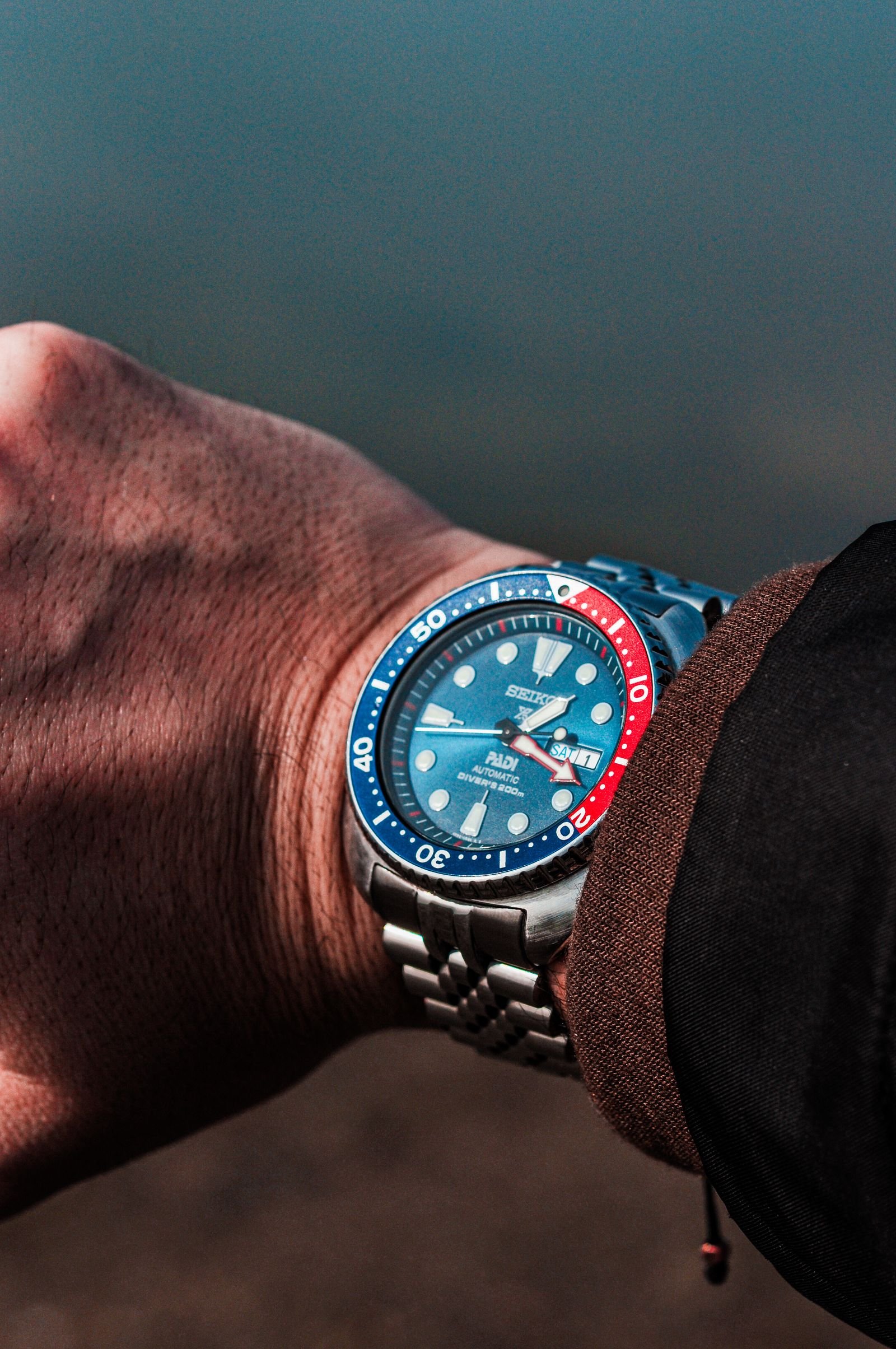
The Omega Seamaster Diver 300M is easy to recognize and surprisingly difficult to authenticate. Its scalloped bezel, skeletonized hands, wave-pattern dial, and helium escape valve create a familiar silhouette, but the collection has changed repeatedly since 1993. Quartz and mechanical models, different case sizes, date and no-date layouts, closed and display backs, special editions, and several bracelet designs are all legitimate.
That history defeats simple “real versus fake” checklists. A detail that is correct for a current 42 mm Master Chronometer can be wrong for an older reference—and the reverse is equally true. Modern counterfeits can also reproduce the obvious design cues convincingly. The reliable approach is to identify the exact reference first, then ask whether the watch, movement, documents, and seller story all describe the same object.
This guide explains how to spot a fake Omega Seamaster Diver 300M without treating any single visual clue as proof. It is designed for screening pre-owned listings and preparing for an in-person inspection. A high-value purchase should still be examined by Omega or a qualified independent watchmaker, especially when the case must be opened or water resistance tested.
Begin With the Full Reference Number
Do not authenticate “a blue Seamaster” as a category. Ask for the complete reference number, clear photographs of the actual watch, and any warranty or service documents. Then compare that reference with an official Omega product page, archived catalog, or reliable period documentation.
A correct reference should resolve several questions at once:
- case material, diameter, and approximate thickness;
- dial and bezel color and material;
- date position or absence of a date;
- bracelet or factory strap configuration;
- caliber and expected crown functions;
- closed, engraved, or sapphire display caseback;
- limited-edition markings, if applicable.
The current collection alone shows why this matters. The familiar ceramic-dial generation includes 42 mm date models powered by Caliber 8800, while Omega has also released 42 mm no-date variants with Caliber 8806, domed sapphire crystals, and different dial materials. Older 36.25 mm and 41 mm models may use quartz or earlier automatic calibers. Rejecting a legitimate watch because it lacks the configuration of another generation is not authentication; it is a reference error.
Check Whether the Dial Belongs to That Reference
Once the reference is established, compare the dial as a complete layout rather than hunting for one famous “tell.” Examine the shape and placement of the applied markers, the length and proportions of the hands, the date window, minute track, wave pattern, and every line of printing.
On a genuine example, small elements should look intentional under magnification. Letter spacing should be even, printed lines should follow the correct curvature, and applied markers should sit squarely in their intended positions. Luminous material should be neatly contained. A crooked logo, fuzzy text, uneven lume, or a date aperture with rough edges is suspicious, but age, service work, moisture damage, and refinishing can also alter an authentic dial.
The wave pattern deserves special caution. Early Diver 300M dials, later smooth dials, modern laser-engraved ceramic waves, and newer no-date designs do not share one texture. Compare the actual watch with official images of the exact reference. A convincing wave pattern cannot authenticate the watch by itself, and the absence of waves is not automatically wrong.
Use Lume as a Consistency Check
Ask for a lume photograph taken after an even charge, but use it to test consistency rather than demand a universal color. The hue, brightness, and bezel-pip treatment must match the reference and period. Hands or markers that age very differently can indicate replacement parts, reluming, moisture exposure, or a counterfeit assembly.
A short lume shot is not conclusive. Camera exposure and charging time can exaggerate brightness, while genuine older lume may have weakened. What matters is whether the pattern agrees with the documented model and whether unexplained mismatches appear alongside other problems.
Inspect the Bezel, Valve, Crown, and Case Geometry
The helium escape valve near 10 o’clock is a defining Diver 300M feature, but its presence proves little because replicas copy it. Check its shape, height, knurling, alignment, and relationship to the case against official reference photographs. The crown and valve should not look like generic parts added to an otherwise convincing case.
Examine the unidirectional bezel at 12 o’clock and at several points around the minute track. The insert typography, luminous pip, scalloped edge, and alignment should match the reference. Bezel action should feel controlled rather than loose or abrasive, but wear and prior repair can affect a genuine watch. Never rely on “the bezel clicks correctly” as proof.
Case finishing supplies better evidence when several observations agree. Look at the boundary between brushed and polished surfaces, the symmetry of the lugs, crown-guard shape, caseback fit, and the way the bracelet meets the case. Heavy polishing can soften genuine edges, so geometry must be interpreted alongside condition. Rough machining, inconsistent finish transitions, incorrect dimensions, and poorly fitting controls together are more meaningful than one soft edge.
Do Not Test Water Resistance Yourself
The “300M” name is not permission to immerse an unknown pre-owned watch. Counterfeit cases may leak, and genuine watches lose water resistance as gaskets age or cases are opened. Ask for a recent professional pressure-test result and have the watch tested again before swimming or diving. Operating the helium valve or opening the case is not a safe authenticity experiment.
Compare the Bracelet and Clasp—But Keep Them in Context
The bracelet can reveal weak manufacturing quickly. Check whether link shape, finishing, taper, end-link fit, clasp architecture, extension system, engraving, and reference codes match the stated model. Screws or pins should correspond to the proper construction, and the clasp should close positively without excessive play.
However, bracelets are interchangeable. A genuine watch head may have an aftermarket strap, a later service bracelet, or a mismatched clasp. A genuine bracelet can also be attached to a counterfeit watch. Treat the bracelet as one component whose identity and condition should be disclosed, not as a certificate for the entire watch.
Verify the Serial, Cards, and Seller’s Story
Record the serial number from its expected location for the reference and compare it with the warranty card, sales invoice, service documents, and any movement record available during professional inspection. Engraving should be clean and consistent with the case, but a plausible serial is not enough. Counterfeiters can copy a real number and reuse it on multiple watches.
Search the visible portion of the serial and the seller’s photographs for reuse, while avoiding publication of the complete number. Check that the stated purchase date, dealer, reference, caliber, and service history form a plausible timeline. A card with mismatched typography or data is concerning, but convincing packaging can also be purchased separately or paired with the wrong watch.
For a Master Chronometer model, understand what the wording actually means. METAS explains that Master Chronometer certification applies to the complete watch and covers chronometric performance, water resistance, magnetic resistance, and power reserve under an independently monitored system. Printed “Master Chronometer” text is not proof; it tells you what the claimed watch should be able to document.
Use the Caseback and Movement as High-Value Evidence
A sapphire caseback can reveal bridge shapes, jewel positions, rotor construction, balance location, screws, engraving, and decoration. Compare all of these with official imagery for the specified caliber. Do not stop at a decorated rotor: some replica movements use cosmetic plates or components shaped to imitate the genuine architecture.
Movement behavior also matters. Crown positions, date adjustment, hacking, hand-setting direction, power reserve, and winding feel should agree with the documented caliber. An imitation may look persuasive through glass yet behave like the generic movement underneath.
Closed-back and vintage examples require more care. Do not ask an untrained seller to remove the caseback, and do not open a water-resistant watch with improvised tools. A qualified watchmaker can inspect the movement safely, compare its caliber and serial information, look for aftermarket or damaged components, replace seals as necessary, and arrange a pressure test.
Even a genuine movement does not automatically make the complete watch correct. “Franken” watches can combine authentic and counterfeit parts or mix components from different references. Authentication must establish that the case, dial, hands, movement, bracelet, serial data, and documents belong together.
Evaluate the Seller and Transaction
Strong watches can be sold badly, and bad watches can be presented beautifully. Reduce transaction risk before debating tiny dial details.
- Request sharp, current photographs of the dial, both case sides, lugs, caseback, clasp, serial area, and included documents.
- Ask for a short video showing winding, time setting, date operation if fitted, bezel action, and the watch running.
- Use a payment method with buyer protection and obtain a written return or inspection period.
- Prefer a seller with a verifiable business identity, consistent history, and clear disclosure of replacement or serviced parts.
- Arrange inspection by Omega or an experienced independent specialist before the return window closes.
Pressure to pay by irreversible transfer, refusal to supply routine photographs, copied listing images, an implausibly low price, or a story that changes under simple questions should outweigh a seller’s assurances. Box and papers do not compensate for an unverifiable watch or unsafe transaction.
A Practical Pre-Purchase Checklist
- Obtain the full reference and serial details.
- Match the case, dial, date, bezel, bracelet, caseback, and caliber to official documentation for that reference.
- Inspect printing, lume, finishing, alignment, and component fit using clear original photographs.
- Check that crown functions and movement behavior match the claimed caliber.
- Reconcile the watch’s serial with cards, invoices, and service records without treating any one item as proof.
- Research the seller and insist on a protected payment and inspection window.
- Have a professional inspect the movement and pressure-test the watch when the purchase value justifies it.
FAQ
Can Omega verify a Seamaster from the serial number alone?
A serial can support an investigation, but it does not prove that the complete watch is genuine. Numbers may be copied, altered, or placed on watches assembled from mismatched parts. Ask Omega or an authorized service provider what records they can confirm, then combine that information with physical inspection.
Does every Seamaster Diver 300M have waves on the dial?
No. Dial treatment varies by generation and reference. Some have prominent waves, some use different wave execution, and some legitimate models have smooth or alternative dials. Always compare with the exact reference.
Does every Diver 300M have a display caseback?
No. Many current mechanical references use sapphire display backs, while older and special models may use closed or decorated backs. The expected caseback must be determined from the full reference.
Is the helium escape valve proof that the watch is genuine?
No. Counterfeiters reproduce the valve, and its visual presence cannot confirm function or water resistance. Its design and placement are consistency checks only.
Can a timegrapher authenticate an Omega Seamaster?
No. Rate, amplitude, and beat error can show whether a mechanical movement appears healthy, but a replica movement can produce acceptable timing numbers. A timegrapher is a condition tool, not an identity test.
Should I open the caseback before buying?
Only through a qualified professional. Improper opening can scratch the case, contaminate the movement, damage seals, and compromise water resistance. Inspection should be followed by appropriate gasket and pressure checks.
Conclusion
To spot a fake Omega Seamaster Diver 300M, make the watch prove one coherent identity. Begin with the full reference, establish the correct specification, and then compare the dial, case, bezel, valve, bracelet, caseback, movement behavior, serial data, documents, and seller story against it.
No logo, wave pattern, serial, box, or timing result can authenticate the watch alone. The safest purchase combines reference-specific research, a protected transaction, and professional inspection. That method also distinguishes a counterfeit from an authentic watch with legitimate service parts—an important difference that simplistic checklists often miss.
Related Reading
- Compare another Omega dive-watch family with our Omega Planet Ocean authentication guide.
- For a broader pre-owned screening process, review ten counterfeit luxury-watch red flags.