
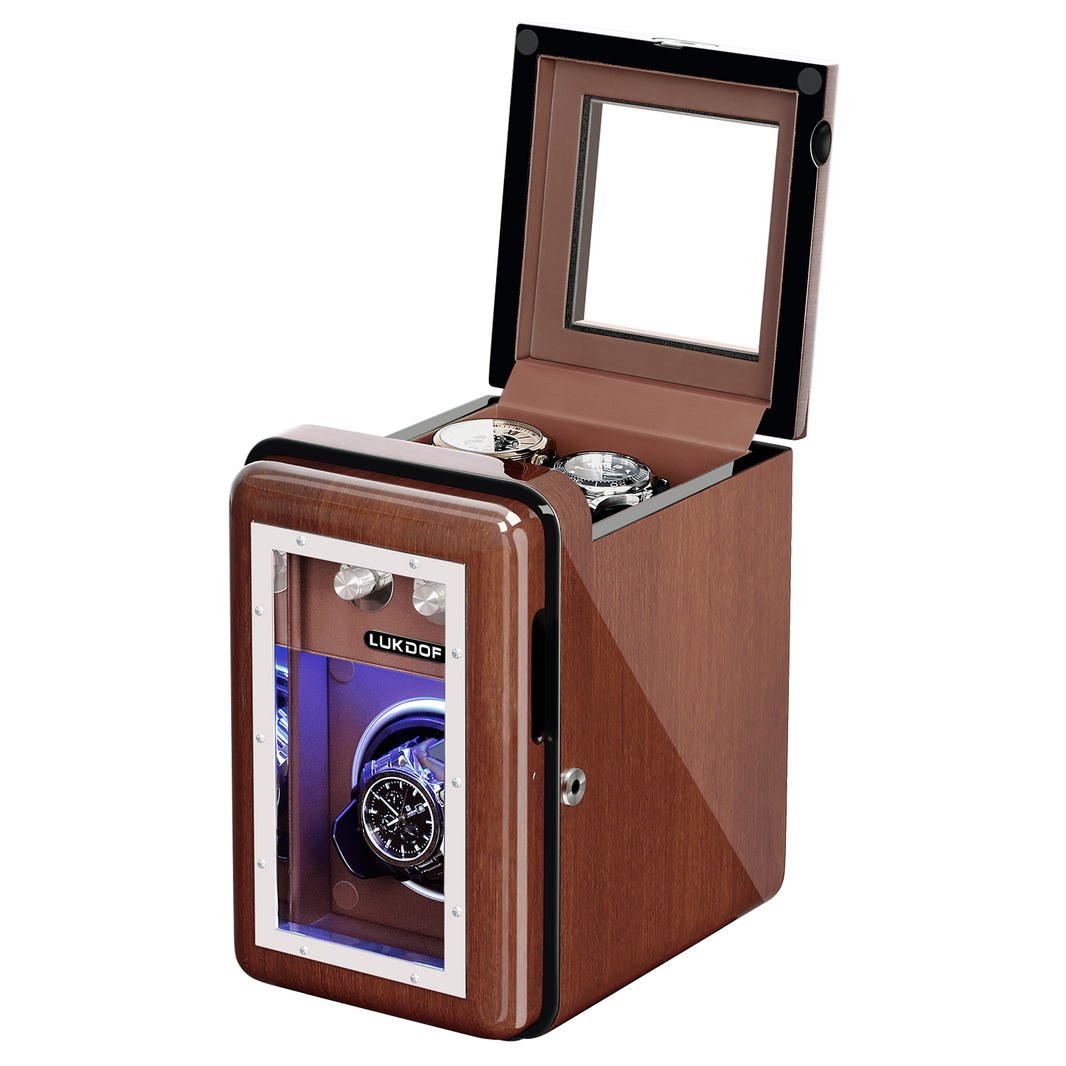
A watch winder is a powered storage device for automatic watches. It turns the watch in controlled cycles while the watch is off the wrist, helping the movement stay wound, the time remain current, and calendar complications stay ready for the next wear.
This guide brings the essential beginner topics into one place: how a watch winder works, what parts it contains, the main types of watch winders, why TPD exists, why different watches need different settings, and how to use a winder without adding unnecessary motion.
How an Automatic Watch Winds Itself
An automatic mechanical watch contains a weighted rotor. When the watch moves on the wrist, the rotor swings and turns. That motion is transferred through the winding system into the mainspring, which stores energy and releases it gradually to power the movement.
The watch is not powered by movement directly. Movement winds the mainspring; the mainspring powers the gear train, escapement, hands, and complications. This distinction matters because a watch winder should not spin a watch constantly. It should deliver measured motion, then allow rest time, much like a watch naturally receives motion and pauses during daily wear.
What a Watch Winder Does
A watch winder rotates an automatic watch in programmed cycles. The purpose is to keep the watch within a useful power range when it is not being worn. It is especially helpful for collectors who rotate several automatic watches or own watches with date, day, GMT, moonphase, annual calendar, or perpetual calendar functions.
A winder does not repair a weak movement, replace regular service, or make every watch more accurate. If a watch loses time badly, stops despite correct settings, or has poor amplitude, the movement may need inspection. The winder simply provides controlled motion to a healthy automatic winding system.
The Main Parts of a Watch Winder
- Motor: The motor turns the winding cup or holder. A quiet brushless motor is preferred for bedrooms, offices, and display areas because it reduces noise and vibration.
- Drive system: Gears, belts, or direct-drive parts transfer motor motion into smooth rotation. Good control matters more than speed.
- Watch cup or rotating holder: This is the moving platform that carries the watch during each cycle.
- Cushion or pillow: The cushion holds the watch securely. It must fit the bracelet or strap firmly enough to prevent sliding, but softly enough to protect the case and bracelet.
- Control module: This sets TPD, rotation direction, start/stop cycles, and sometimes independent programs for each slot.
- Cabinet or case: The outer body protects the watch and defines the display style. Materials may include hardwood, piano lacquer, glass, leather, carbon fiber, or metal.
- Power system: Most winders use AC power; some compact units also support batteries for placement flexibility.
- Storage features: Multi-watch winders may include drawers, locking doors, LED lighting, extra watch cushions, or accessory storage.
Common Types of Watch Winders
The best form depends on the size of the collection, where the winder will sit, and whether each watch needs independent settings.
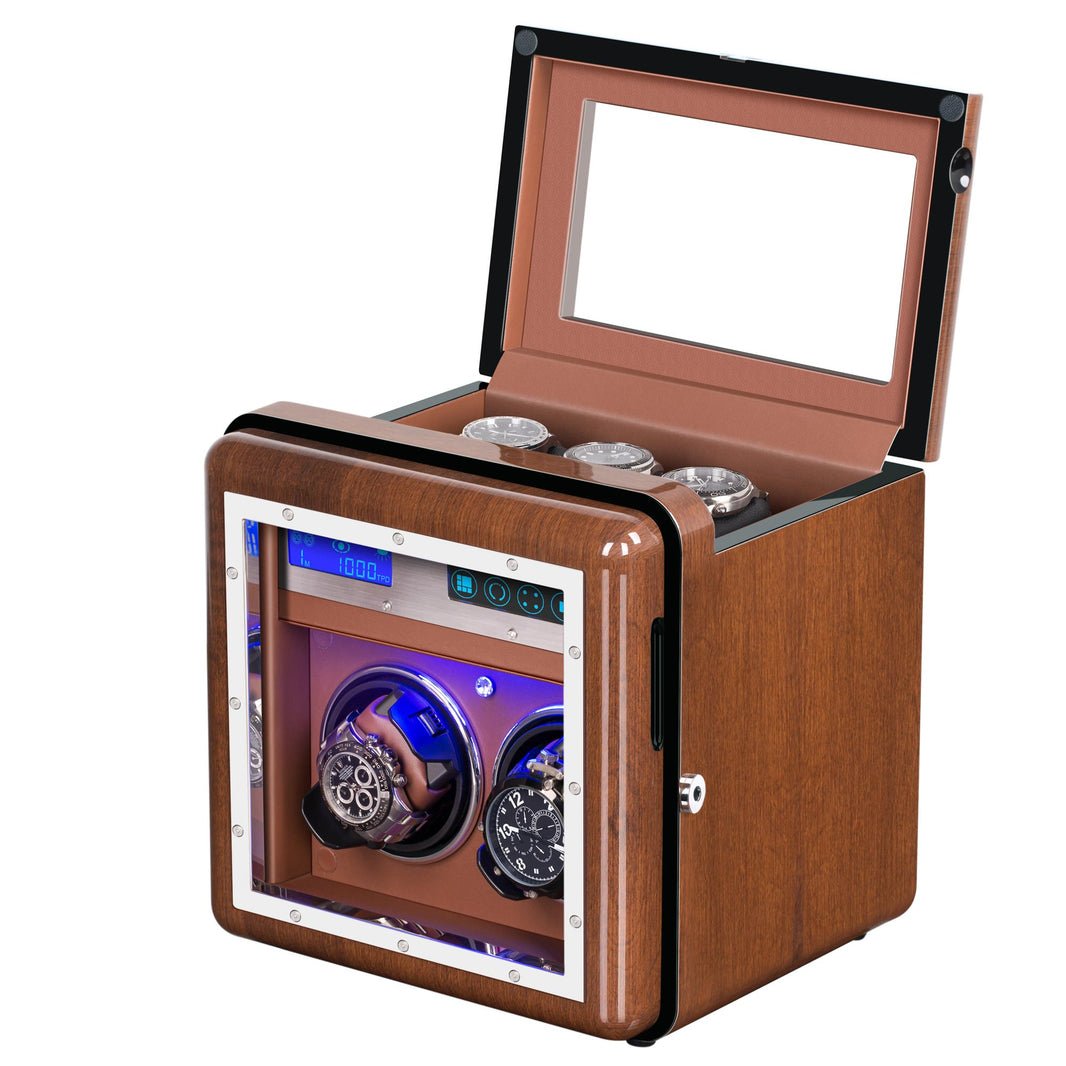
- Single watch winders: Best for one automatic watch or a first collector setup. They are simple, compact, and easy to place.
- Double watch winders: Good for rotating two daily watches or keeping one formal watch and one sport watch ready.
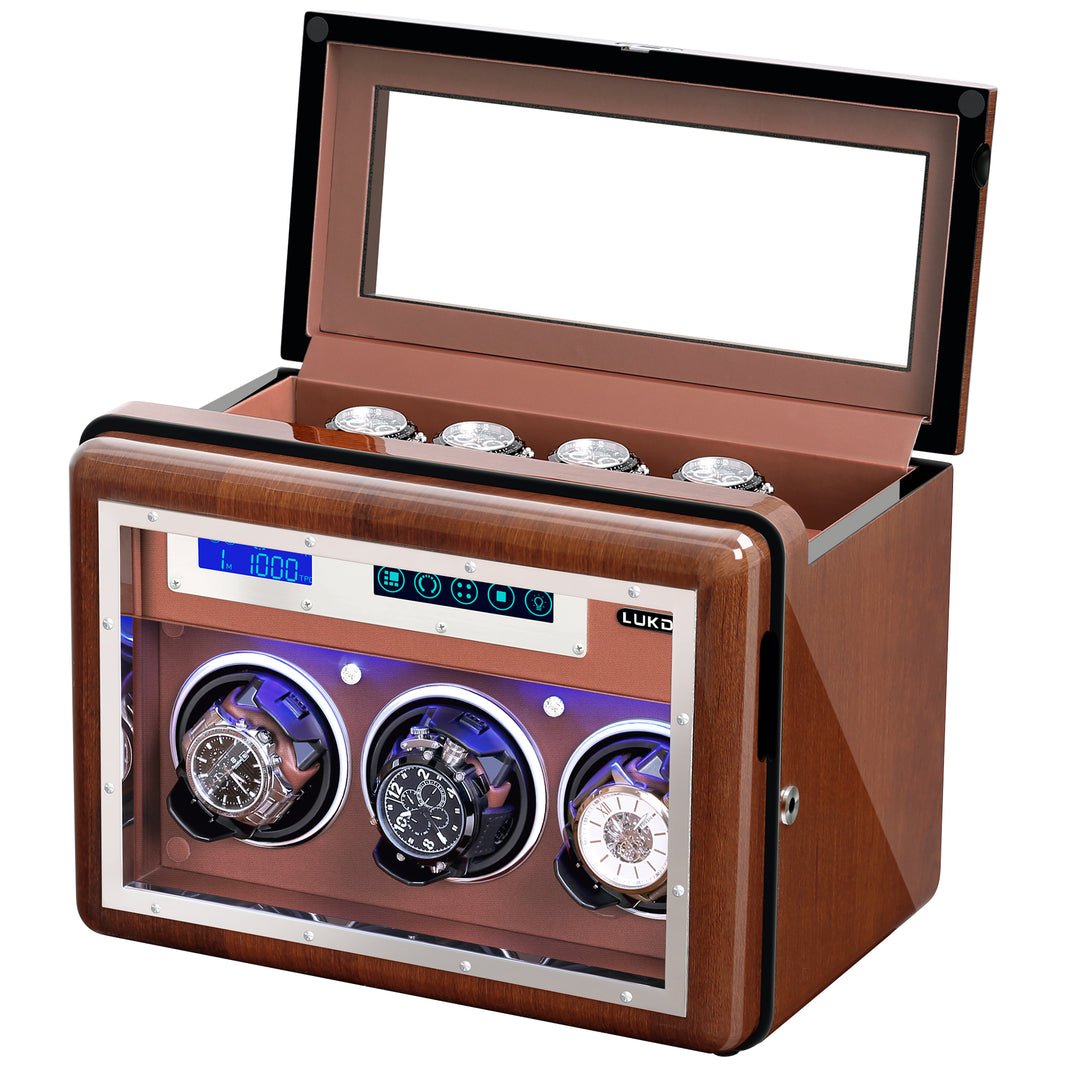
- Multi-watch winders: Designed for larger collections. Independent controls are important because different watches can require different TPD and direction settings.
- Watch winder cabinets: Larger display furniture for collectors who want winding slots plus storage drawers or extra cushions.
- Watch winder safes: Security-focused units that combine winding with locked storage. These are useful for higher-value collections.
- Stackable or modular winders: Units designed to expand over time as the collection grows.
- Travel or compact winders: Smaller units for temporary use, though many collectors still prefer a stable home cabinet for long-term storage.
What TPD Means
TPD means turns per day. It describes how many full rotations the winder gives the watch over a 24-hour period. A setting of 650 TPD does not mean the watch spins 650 times at once. A properly programmed winder spreads those turns across multiple cycles with rest periods between them.
TPD exists because automatic movements are mechanical systems with different winding efficiencies. Some movements wind efficiently with modest movement. Others need more motion to maintain power reserve. The right TPD is the amount of motion that keeps the watch running reliably without unnecessary excess.
Why Different Watches Have Different TPD Recommendations
Different watches can need different TPD settings because the movement design is different. The rotor weight, winding gear train, reverser wheels, mainspring barrel, power reserve, and winding direction all affect how efficiently wrist motion becomes stored energy.
- Movement architecture: Two watches from different brands may use very different automatic winding systems.
- Winding direction: Some movements wind clockwise, some counterclockwise, and some in both directions.
- Power reserve: A longer power reserve can affect how much daily winding is needed to maintain a comfortable energy level.
- Complications: Watches with calendars, GMT, or moonphase functions are often kept running for convenience, so stable winding matters more.
- Wearing pattern: A watch worn often may need less winder support than one stored for several days at a time.
- Movement condition: A dry or service-due movement may behave differently even when the winder setting is correct.
Many everyday automatic watches sit comfortably in a moderate range, often around 650 to 900 TPD, but this is only a starting range. When possible, confirm the exact movement and follow the movement maker or a reliable TPD reference. For deeper setting work, read the TPD Guide.
Rotation Direction: Clockwise, Counterclockwise, or Both
Rotation direction matters because not every automatic movement winds in both directions. If a movement winds only clockwise and the winder is set only counterclockwise, the rotor may move but the mainspring may not gain useful energy.
If you do not know the correct direction, a bidirectional mode can be a reasonable starting point when the winder offers it. The better answer is to identify the movement and set direction according to that movement’s requirement. Direction and TPD should always be treated together, not as separate guesses.
Can a Watch Winder Overwind an Automatic Watch?
Modern automatic watches include protection that helps prevent the mainspring from being wound beyond its limit. This is why a healthy automatic watch normally cannot be overwound in the simple sense. However, that does not mean more motion is better.
The refined approach is to use the lowest reliable setting that keeps the watch running. Excessive TPD may not overwind the mainspring, but it can add unnecessary movement, noise, and wear to the automatic system. A good winder should be controlled, quiet, and conservative.
When a Watch Winder Is Most Useful
- You rotate more than one automatic watch.
- Your watch has a date, day, GMT, moonphase, annual calendar, or perpetual calendar.
- You want a watch ready to wear after several days off the wrist.
- You prefer a protected display cabinet instead of leaving watches loose on a table.
- You want a consistent storage habit for a growing collection.
A winder is less necessary for quartz watches, manual-wind watches, or a single automatic watch worn every day. Those watches still need safe storage, but not automatic winding motion.
Basic Setup Checklist
- Identify the watch movement if possible.
- Wind and set the watch manually before placing it in the winder.
- Fit the watch firmly on the cushion so it cannot slide or rub.
- Choose the correct rotation direction: clockwise, counterclockwise, or bidirectional.
- Start with a conservative TPD setting based on the movement or a trusted reference.
- Observe the watch over 48 to 72 hours.
- If the watch stops, increase TPD gradually or recheck direction.
- If the watch stays fully ready, avoid raising the setting just because a higher number is available.
Watch Winder Basics FAQ
1. Do I need a watch winder for every automatic watch?
No. A winder is most useful for watches that are rotated, stored for several days, or difficult to reset. A daily-worn automatic watch may not need one.
2. What is the most important watch winder setting?
TPD and rotation direction are the two key settings. A good TPD number will not help if the movement is rotating in the wrong direction.
3. Is higher TPD safer?
No. Higher TPD is not automatically better. Use enough turns to keep the watch running, then avoid unnecessary extra motion.
4. Can a watch winder damage a watch?
A quality winder used with reasonable settings should be safe for a healthy automatic watch. Poor fit, excessive motion, vibration, and incorrect direction are the larger concerns.
5. Should the winder run all day?
No. A proper winder uses cycles and rest periods. Continuous spinning is unnecessary for normal watch care.
6. Can I put a manual-wind watch on a winder?
You can store it there if it fits safely, but the winder will not wind it. Manual-wind watches do not have the automatic rotor system that winders are designed to move.
7. Why does one automatic watch stop while another keeps running on the same winder?
They may use different movements, winding directions, or TPD requirements. One slot setting rarely suits every watch in a collection.
8. Should I fully wind the watch before placing it in the winder?
Yes, it is usually best to start with the watch wound and correctly set. A winder is better at maintaining power than rescuing a watch that is already nearly stopped.
9. Is a quiet motor important?
Yes. A quiet motor matters if the winder sits in a bedroom, office, dressing room, or display space. It also reflects better control and a more refined ownership experience.
10. What should I read after learning the basics?
Next, read the TPD Guide for settings, then How to Choose a Watch Winder for buying criteria.
Continue Learning
- How to Choose a Watch Winder – compare capacity, independent controls, motor quality, cushion fit, cabinet style, and security.
- TPD Guide – match turns per day and rotation direction to your movement.
- FAQS – read common questions about watch winders, ordering, warranty, and support.
- BLOG – explore future collector notes, ownership tips, and Galosom updates.
- Shop Galosom Watch Winders – view single, double, and multi-watch winders.