



























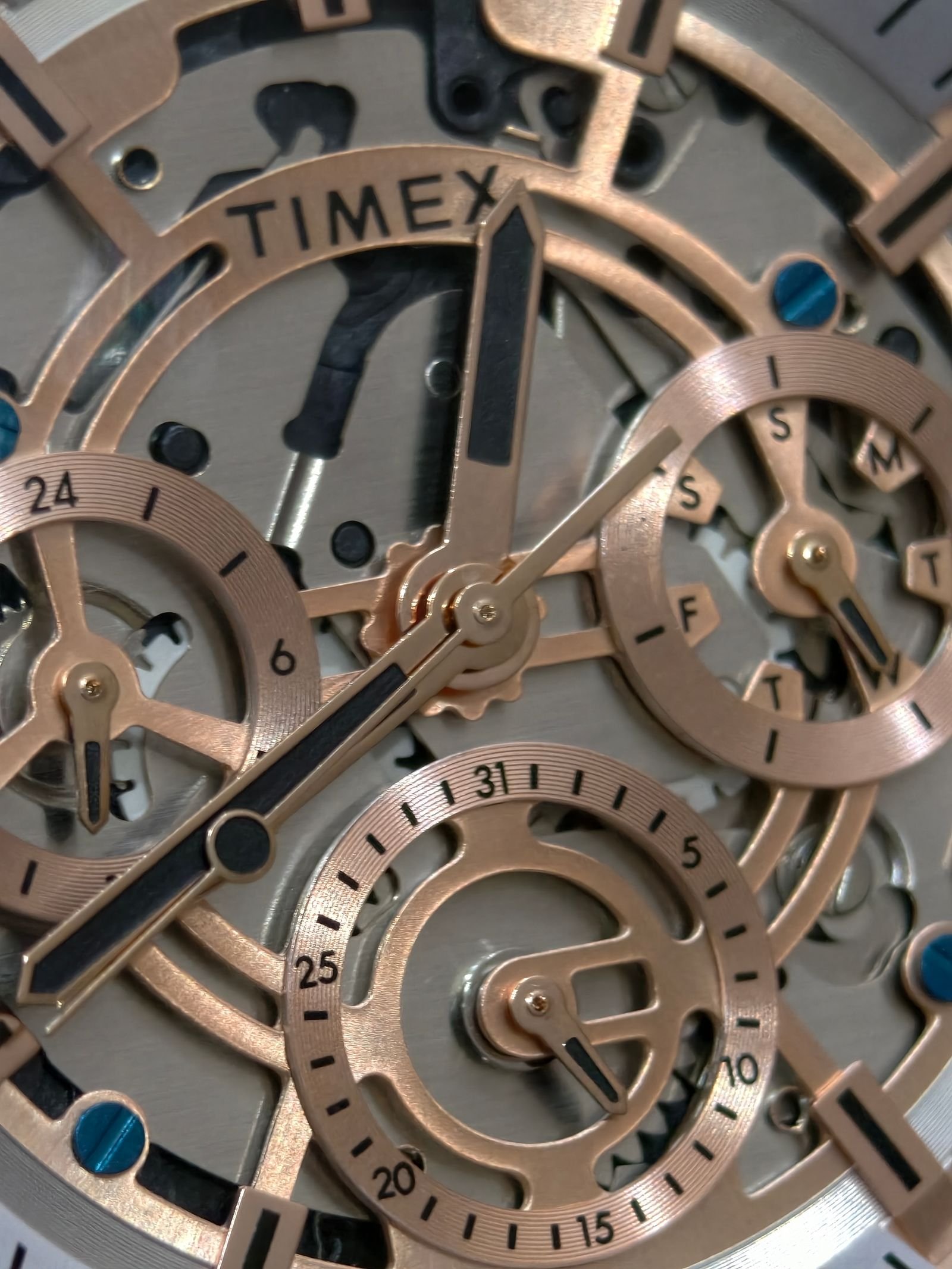
“Free-sprung balance” has become a prestige phrase in modern watch specifications. It often appears beside silicon hairsprings, full balance bridges, chronometer certificates, and long power reserves. The implication is that free-sprung automatically means more accurate, while a conventional regulated balance is somehow second-rate.
The real distinction is more useful and less dramatic. Both systems can keep excellent time. They differ mainly in how a watchmaker changes the oscillator’s rate. A regulated balance alters the effective length of the hairspring with an index and curb pins. A free-sprung balance leaves the spring’s working length fixed and changes the balance wheel’s inertia with adjustable weights or screws.
That difference affects long-term stability, shock sensitivity, manufacturing cost, and service technique. It does not, by itself, determine how accurately a complete watch performs. Escapement quality, hairspring geometry, balance poise, lubrication, power delivery, positional adjustment, casing, and final quality control all remain important.
What Does the Balance Assembly Do?
A mechanical watch does not release mainspring energy continuously. The escapement meters that energy in small steps, while the balance wheel and hairspring form an oscillator that sets the pace. The balance turns one way, the spring pulls it back, and the cycle repeats thousands of times per hour.
The rate depends on two broad properties: the hairspring’s restoring behavior and the balance wheel’s moment of inertia. In simplified terms, a shorter effective spring makes the oscillator cycle faster, while a balance with greater inertia cycles more slowly. Watchmakers can therefore adjust rate by changing the spring’s effective length or by changing the distribution of mass on the balance.
Those are the two approaches behind regulated and free-sprung systems. Neither changes the oscillator’s basic job. Both bring a real mechanism, made from physical parts with tiny tolerances, into its intended rate range.
How a Regulated Balance Adjusts Rate
On a traditional regulated movement, the outer portion of the hairspring passes between two curb pins attached to a movable regulator index. Moving the index changes the point at which the spring is constrained, altering its effective active length.
- Shortening the active spring generally makes the watch run faster.
- Lengthening the active spring generally makes the watch run slower.
- A fine-adjustment screw or eccentric may allow smaller, more repeatable changes than pushing the index directly.
This design is compact, economical, and practical to service. It lets a trained watchmaker correct rate without removing the balance or manipulating tiny inertia weights. Many reliable Swiss and Japanese movements use an index regulator, including calibers that can be adjusted to strong real-world accuracy.
The compromise is that the curb pins interact with the spring. Their spacing, alignment, and relationship to the spring matter. If the regulator shifts after a hard impact, the rate can change. Poorly positioned pins may also influence how concentrically the spring breathes as amplitude and position change. A well-made and correctly adjusted regulator minimizes these effects.
How a Free-Sprung Balance Adjusts Rate

A free-sprung system removes the conventional regulator index. The hairspring’s active length remains fixed after assembly. To change the rate, a watchmaker adjusts small weights, screws, or masselottes on the balance wheel.
Moving mass outward increases the wheel’s moment of inertia and generally slows the rate. Moving it inward reduces inertia and generally speeds the rate. The exact tool and direction depend on the movement. Opposing weights normally need coordinated adjustment so the balance remains poised rather than becoming heavier on one side.
Grand Seiko’s description of Caliber 9SA5 provides a clear modern example: its free-sprung balance uses four recessed screws in the rim, paired with an overcoil developed to improve performance across positions. Citizen’s Calibers 0200 and 0210 also use adjustable masselottes and are tested as complete watches for 17 days in six positions and three temperature bands. Tudor describes the MT5612’s variable-inertia oscillator together with a silicon spring and a balance bridge fixed on both sides.
These examples reveal an important point: the brands do not rely on the free-sprung layout alone. They combine it with carefully designed springs, stable support structures, precise components, positional testing, and controlled assembly.
Why Brands Choose a Free-Sprung Design
There Is No Regulator Index to Shift
Removing a movable index eliminates one part that can be displaced. This can help a well-engineered oscillator retain its adjustment after everyday knocks and over long periods. Citizen associates its free-sprung mechanism with resistance to shock and change over time, while Grand Seiko emphasizes sustained precision and hairspring durability.
That does not make the watch shockproof. A sufficiently hard impact can still damage pivots, jewels, the balance staff, hairspring, bridge, or escapement. The advantage is a reduction in one possible source of rate drift, not immunity from physical damage.
The Hairspring Can Breathe Without Curb-Pin Control
Because the active length is not defined by regulator pins, designers have more freedom to optimize the terminal shape and concentric breathing of the spring. This can support stable behavior as the watch moves through different positions and states of wind.
Execution still matters. A free-sprung watch with a poorly formed, contaminated, or off-center spring will not outperform a carefully adjusted regulated movement merely because its index is absent. The spring must still be manufactured, fitted, centered, and paired correctly with the balance and escapement.
Adjustment Can Be Stable and Repeatable
Variable-inertia regulation allows rate changes without sliding an index along a scale or altering the working spring length. With the correct movement-specific tool and procedure, a watchmaker can make controlled adjustments while preserving the designed spring geometry.
The cost is greater complexity. Tiny opposing weights are less convenient than a conventional regulator, and careless adjustment can disturb poise. Production requires tight tolerances, while service requires knowledge, tooling, and patience. That helps explain why free-sprung systems are common in premium calibers but are not automatically the sensible answer for every affordable workhorse.
Does Free-Sprung Mean More Accurate?
Not necessarily. Architecture creates potential; testing and adjustment determine the result. An inexpensive regulated movement can be adjusted to a very good average rate, while a free-sprung movement can perform poorly if it is damaged, magnetized, under-lubricated, badly poised, or inadequately regulated.
Accuracy should be judged from evidence:
- the maker’s stated tolerance for the exact caliber;
- daily results averaged over several days of normal wear;
- rate consistency across horizontal and vertical positions;
- amplitude and beat error at an appropriate state of wind;
- power-reserve performance and stability as torque declines;
- any chronometer or brand-specific testing applied to the complete watch.
Citizen’s -3/+5 seconds-per-day claim for Calibers 0200 and 0210 is meaningful because it sits beside a defined complete-watch test. Grand Seiko’s stated +5/-3 seconds-per-day standard for the 9SA5 similarly belongs to a complete movement and quality-control system. The free-sprung balance contributes, but it is not the only reason those results are possible.
Free-Sprung Does Not Mean “Unregulated”
The terminology causes confusion. “Free-sprung” does not mean the watch leaves the factory without rate adjustment. It means the oscillator has no conventional index regulator acting on the spring. The rate is still regulated—by changing balance inertia.
Likewise, “regulated balance” is not a criticism. It describes an oscillator using index-based rate adjustment. A movement can be regulated in multiple positions, fitted with a sophisticated fine-adjustment mechanism, and certified as a chronometer while retaining a conventional index.
When comparing specifications, look for phrases such as “variable inertia,” “indexless balance,” “adjustment weights,” or brand-specific systems. A display back may reveal screws or weights on the balance rim, but appearance alone is not conclusive. Official caliber documentation is safer than guessing from a photograph.
Service and Ownership Differences

For an owner, neither design demands a special daily routine. Wind and wear the watch as its manufacturer recommends, protect it from severe shock and magnetic exposure, and evaluate accuracy over several days rather than from one short reading.
The difference becomes more important at the bench. A conventional index can make basic rate correction faster, but the watchmaker must also assess curb-pin geometry and spring behavior. A free-sprung balance may hold adjustment well, yet fine regulation can take longer and may require proprietary or caliber-specific tools. Some designs call for matched changes to opposing screws; adjusting only one side can introduce poise error and worsen positional performance.
Neither adjustment is a sensible do-it-yourself job on a valuable watch. Moving a regulator too far can produce a large rate change, and touching the hairspring can deform it. Mishandling free-sprung weights can scratch components, damage screws, or unbalance the oscillator. Opening the case also creates dust, gasket, and water-resistance concerns.
If accuracy suddenly changes after a drop, do not assume the problem is merely regulation. A watchmaker should check magnetism, balance freedom, hairspring condition, amplitude, beat error, positional spread, and signs of impact before changing the rate. Regulation can make one number look better while leaving an underlying defect untouched.
Which System Is Better for a Buyer?
Choose the watch, not the isolated feature. A free-sprung balance is a credible engineering advantage when it belongs to a well-designed, thoroughly tested caliber with accessible service support. It can offer stable adjustment and remove curb-pin influence. That is genuinely valuable.
A regulated balance is often easier and less costly to manufacture and service. In a robust movement with good parts, sensible spring geometry, and careful multi-position adjustment, it can deliver excellent practical timekeeping. It may also be easier for independent watchmakers to regulate decades later.
Before paying a premium, ask better questions:
- What accuracy range does the brand promise for the complete watch?
- Is the movement tested in several positions and at more than one state of wind?
- Can qualified service centers and independent specialists obtain tools and parts?
- How does the actual watch perform over a week of normal use?
- Are power reserve, amplitude, beat error, and positional consistency healthy?
A prestigious oscillator cannot compensate for weak service access or poor condition. Conversely, a humble regulated caliber with documented maintenance and steady performance may be the more dependable purchase.
FAQ
Is a free-sprung balance the same as a full balance bridge?
No. Free-sprung describes how rate is adjusted. A full balance bridge describes how the balance assembly is supported. The two features often appear together, but a movement can use one without the other.
Can a free-sprung balance be regulated by a watchmaker?
Yes. The watchmaker changes the balance wheel’s inertia using adjustment screws or weights. The procedure is movement-specific and should preserve poise through coordinated changes where required.
Are all chronometer watches free-sprung?
No. Chronometer performance is based on test results, not one mandatory architecture. Both regulated and free-sprung movements can achieve strong certified accuracy when properly designed and adjusted.
Is a free-sprung watch more resistant to shocks?
It removes the risk of a movable regulator index shifting, which can improve rate stability. However, the balance staff, spring, jewels, escapement, and supporting structure can still be damaged. Overall shock resistance depends on the complete design.
Can I identify a free-sprung balance through a display back?
Sometimes. You may see adjustment weights on the balance rim and no regulator index on the balance cock or bridge. Confirm with official caliber documentation because components may be obscured and visual assumptions can be wrong.
Conclusion
The difference between a free-sprung and regulated balance is fundamentally a difference in rate adjustment. A regulated oscillator changes the hairspring’s effective length; a free-sprung oscillator keeps that length fixed and changes balance inertia.
Free-sprung construction can support stable adjustment, reduce interference with spring breathing, and remove a movable index. It also costs more to manufacture and demands careful, movement-specific regulation. A conventional regulator remains a sound, serviceable solution capable of excellent accuracy.
The useful buying or diagnostic question is not simply “Does it have a free-sprung balance?” but “How well has the complete watch been designed, adjusted, tested, maintained, and supported?”
Related Reading
- Learn how timing changes should be assessed in our guide to a mechanical watch running fast after service.
- For another key timegrapher measurement, read this practical explanation of mechanical watch beat error.