

A vertical vs horizontal clutch chronograph comparison is really a study of how a mechanical stopwatch borrows power from the watch beneath it. One system joins rotating parts through friction on a shared axis; the other moves toothed wheels sideways into mesh. That difference can affect the way the chronograph seconds hand starts, how much of the mechanism is visible, and what a watchmaker must adjust during service. It does not, by itself, decide whether the complete watch is accurate, durable, or worth its price.
The distinction is also easy to confuse with another familiar specification. A column wheel or cam controls the sequence of start, stop, and reset. A vertical or horizontal clutch transmits power to the chronograph. These are separate jobs, so a movement can pair a column wheel with either clutch type. Understanding that separation turns a list of prestige terms into useful buying information.
The short answer
A horizontal clutch, also called a lateral clutch, swings or slides a coupling wheel into the chronograph runner. The engagement happens in a plane that is easy to see through an open caseback. Because two sets of teeth must meet, the central chronograph hand may make a tiny initial movement if the teeth do not engage at the ideal point.
A vertical clutch stacks the driving and driven parts on the same axis and brings friction surfaces together. It usually starts the central hand with less visible jump and can transmit power without a pair of coupling teeth repeatedly entering and leaving mesh. The assembly is compact and often hidden beneath a bridge or dial-side components, so its operation may be less theatrical to observe.
Neither description is a verdict. A properly adjusted horizontal clutch can start cleanly and remain dependable for decades. A vertical clutch still depends on correct tolerances, lubrication, spring forces, and service. The execution of the whole calibre matters more than the label alone.
What a chronograph clutch actually does
A mechanical chronograph contains an ordinary timekeeping train and an elapsed-time mechanism. When the stopwatch is stopped, its recording hands are locked and the coupling is disengaged. Pressing start releases the brake and connects the chronograph to the running train. Pressing stop disconnects or arrests the recording system; pressing reset lets hammers act on heart-shaped cams so the hands return to zero.
The clutch is the connection in that sequence. It is not the pusher, the brake, the reset hammer, or the component that regulates the balance. This is why clutch type cannot tell you how soft the pushers will feel or what daily rate the watch will deliver. Pusher feel also depends on the switching system, springs, case tubes, seals, and adjustment.
The Seiko Museum’s explanation of mechanical chronograph mechanisms divides clutch systems chiefly into horizontal and vertical types. Its diagrams show the essential geometry: horizontal coupling moves a transmission wheel into the chronograph runner, while vertical coupling places the driving and chronograph elements above and below each other on common axes.
How a horizontal clutch works
In a classic horizontal layout, a wheel continuously driven by the timekeeping train powers a coupling wheel. Starting the chronograph moves that coupling wheel laterally until its teeth engage the central chronograph wheel. The chronograph seconds hand, mounted to the relevant arbor, then begins to travel. Stopping reverses the action and the coupling wheel moves away.
This arrangement has one immediate appeal: its logic is visible. On a movement designed to display the mechanism, the owner can watch a lever carry the wheel into engagement. Traditional horizontal-clutch chronographs are therefore valued not only as instruments but also as kinetic demonstrations of mechanical cause and effect.
The engagement depth must be adjusted carefully. Too shallow and the teeth can skip or engage unreliably. Too deep and friction, wear, or poor running can result. Tooth profiles are designed to enter mesh, yet their relative positions at the instant of starting can still produce a small jump of the central hand. A barely perceptible nudge is not automatically a defect; a large leap, repeated hesitation, or continuing flutter deserves inspection.
Oscillating-pinion and carrying-arm variations
“Horizontal clutch” covers more than one construction. A traditional carrying arm physically brings an intermediate wheel into engagement. An oscillating pinion uses a small, movable pinion to connect the base train and chronograph. Both create a lateral geared connection, but their packaging, parts count, appearance, and service procedures differ.
This distinction matters when comparing service costs or historical significance. Two watches described as horizontal-clutch chronographs may share the same broad principle while using very different components. Always identify the exact calibre rather than assuming every lateral system behaves like a hand-finished traditional movement.
How a vertical clutch works
A vertical clutch places its coupling surfaces on a common axis. One part is driven while the watch runs; another is connected to the chronograph seconds hand. When the chronograph starts, spring pressure allows the relevant friction surfaces to contact and rotate together. When it stops, lifting pieces separate them and a brake holds the recording hand.
Because engagement does not require two sets of teeth to find mesh, the start is normally smooth. Rolex describes Calibre 4131 as using a column wheel and vertical clutch for an instantaneous, precise start. Seiko likewise identifies the vertical clutch in its Calibre 8R48 as a system intended to reduce hand skipping during starting and stopping. These are claims about well-developed complete mechanisms, not proof that every vertical clutch performs identically.
The assembly can also support a centrally located chronograph runner without a conventional tension spring used to control geared flutter. That may reduce one source of drag when the chronograph runs. However, vertical-clutch designs differ, and other springs or loads can still influence amplitude. A buyer should not assume that activating any vertical-clutch chronograph has zero effect on rate or reserve.
Vertical vs horizontal clutch chronograph: practical differences
Start-up behavior
The most noticeable difference is often the first fraction of a second. A vertical clutch normally begins without the tooth-position jump possible in a horizontal system. This can matter when timing very short events, although the user’s reaction time is usually a larger source of error in everyday use.
With a horizontal clutch, observe rather than obsess. A small one-time nudge can be a characteristic of geared engagement. A hand that jumps several markers, pauses before moving, or shudders throughout operation suggests poor adjustment, contamination, wear, or another fault—not simply “normal horizontal clutch behavior.”
Continuous running
Vertical clutches are often described as suitable for leaving the chronograph on because the connection relies on friction surfaces rather than a lateral pair of meshing teeth and an anti-flutter spring. That can be a reasonable design advantage, but it is not universal permission to ignore the manual. The chronograph still drives extra wheels and counters, and its effect on reserve or amplitude is calibre-specific.
Running a horizontal-clutch chronograph occasionally is exactly what it was built to do. There is no need to avoid the function out of fear. Leaving it on permanently may add load and wear in ways that vary with the construction. If continuous central seconds is important to you, choose a watch whose manufacturer explicitly supports that use instead of relying on a broad rule.
Visibility and finishing
A horizontal clutch wins the visual contest for many collectors. Its coupling wheel, levers, and engagement can often be seen working through the caseback. Those parts also give a manufacturer room for polished edges, grained levers, and traditional finishing.
A vertical clutch is frequently buried within the movement. It may deliver technically cleaner engagement while offering less to watch. That is not inferior finishing; it is a consequence of packaging. Decide whether you value the spectacle of visible machinery or the functional behavior at the dial.
Thickness and layout
Clutch type alone does not determine case thickness. Integrated versus modular construction, automatic winding, counter layout, date mechanism, bridges, and water-resistance requirements all affect dimensions. A vertical assembly stacks components, while a lateral system spreads parts across the movement, but clever engineering can make either approach compact.
Service considerations
Horizontal clutches require precise depth and alignment where the wheels meet. Vertical clutches require clean friction surfaces, correct lift, suitable spring pressure, and adherence to the maker’s lubrication or replacement instructions. Some vertical clutch components are treated as assemblies rather than repaired part by part. Vintage horizontal systems may instead present scarce wheels or worn pivots.
Ask who can service the exact calibre and whether the brand supplies parts. A theoretically advanced movement is a poor ownership match if no qualified workshop in your region can support it. Conversely, a familiar industrial chronograph may be easier and less expensive to maintain even if its specifications sound less exotic.
Do not confuse clutch type with column wheel versus cam
The control system decides when the chronograph changes state; the clutch decides how it receives power. Rolex Calibre 4131 combines a column wheel with a vertical clutch. Many classical chronographs combine a column wheel with a horizontal clutch. Cam-controlled movements can use lateral coupling, and other combinations also exist.
This distinction prevents a common buying mistake. A smooth start is usually associated more directly with clutch execution than with the presence of a column wheel. A crisp pusher action may be associated with a column wheel, but even that sensation is influenced by the case and adjustment. For a deeper comparison of the controller itself, see this guide to column-wheel and cam chronographs.
What to check before buying a chronograph
- Identify the exact movement. Model families sometimes change calibres across references or generations.
- Separate the specifications. Confirm the switching system, clutch type, integrated or modular construction, frequency, and reserve independently.
- Start the chronograph several times. The hand should begin promptly and behave consistently. Do not judge one tiny nudge without repetition.
- Let it run through a counter change. Watch the minute recorder advance and listen for abnormal scraping or a sudden stop.
- Stop and reset correctly. On a conventional chronograph, stop before resetting. Only a designated flyback movement should be reset while running.
- Check zero alignment. All recording hands should return to the same reference marks after repeated cycles.
- Compare ordinary timekeeping. A dramatic rate change, severe reserve loss, or stopping with the chronograph engaged calls for professional diagnosis.
- Review service evidence. An invoice from a qualified workshop is more useful than an unsupported “recently serviced” claim.
If the hands do not return consistently, do not force the reset pusher. This guide to a chronograph that will not reset to zero explains why quartz calibration and mechanical reset faults require different responses.
Common myths
“Vertical clutch always means higher quality”
No. It offers real engineering benefits, especially smooth engagement, but design quality, manufacturing tolerances, regulation, finishing, parts support, and maintenance history still determine the complete result.
“A horizontal-clutch start jump means the watch is broken”
Not necessarily. A slight initial movement can occur as teeth enter mesh. Large or inconsistent jumps, delayed starts, and persistent flutter are stronger warning signs.
“Column wheel and vertical clutch mean the same thing”
No. The column wheel coordinates commands. The clutch transmits power. They may work together, but they describe different subsystems.
“You should never run a chronograph for long”
Chronographs are designed to run. The sensible limit depends on the calibre and manufacturer guidance. Continuous operation may affect reserve or amplitude, but occasional normal use is not abuse.
Frequently asked questions
Which clutch type is better for precise starts?
A well-executed vertical clutch generally minimizes visible hand jump because it engages friction surfaces on a common axis rather than meshing lateral teeth. Actual elapsed-time accuracy also depends on dial resolution, movement rate, and the operator.
Can a horizontal-clutch chronograph be high-end?
Absolutely. Many respected traditional chronographs use horizontal coupling because it is historically important, visually expressive, and capable of excellent performance when properly adjusted.
Does a vertical clutch eliminate amplitude loss?
No. It can remove certain sources of drag, but running the chronograph still adds mechanical work. The effect depends on the complete movement, its condition, and how its counters are driven.
Can I identify the clutch from the dial?
Usually not. Start-up behavior may offer a clue, but it is not proof. Consult the manufacturer’s technical information for the exact calibre or ask a qualified watchmaker.
Is a tiny start jump acceptable?
On a horizontal clutch, a small, consistent nudge can be characteristic. A large jump, hesitation, failure to start, or continuing irregular motion should be checked.
Which type is cheaper to service?
There is no universal answer. Parts availability, movement architecture, workshop access, brand policy, and condition usually matter more than clutch category alone.
Conclusion
The vertical clutch is usually the cleaner solution at the instant of engagement: it starts smoothly and avoids bringing lateral gear teeth into mesh. The horizontal clutch offers visible mechanical drama, traditional construction, and excellent performance when correctly adjusted. Neither is a shortcut to judging the whole watch.
For buyers, the useful hierarchy is simple: confirm the exact calibre, understand the clutch and controller as separate systems, test the function, and prioritize condition and service support. Buy the chronograph that behaves well and can be maintained—not the one with the longest list of fashionable movement terms.
Related reading
Continue with Galosom’s guide to diagnosing a chronograph that will not reset to zero, then compare the separate control question in Watch Winder Mall’s explanation of column-wheel versus cam chronographs.
Collector’s Pick
A practical watch-storage option selected for readers of this guide.
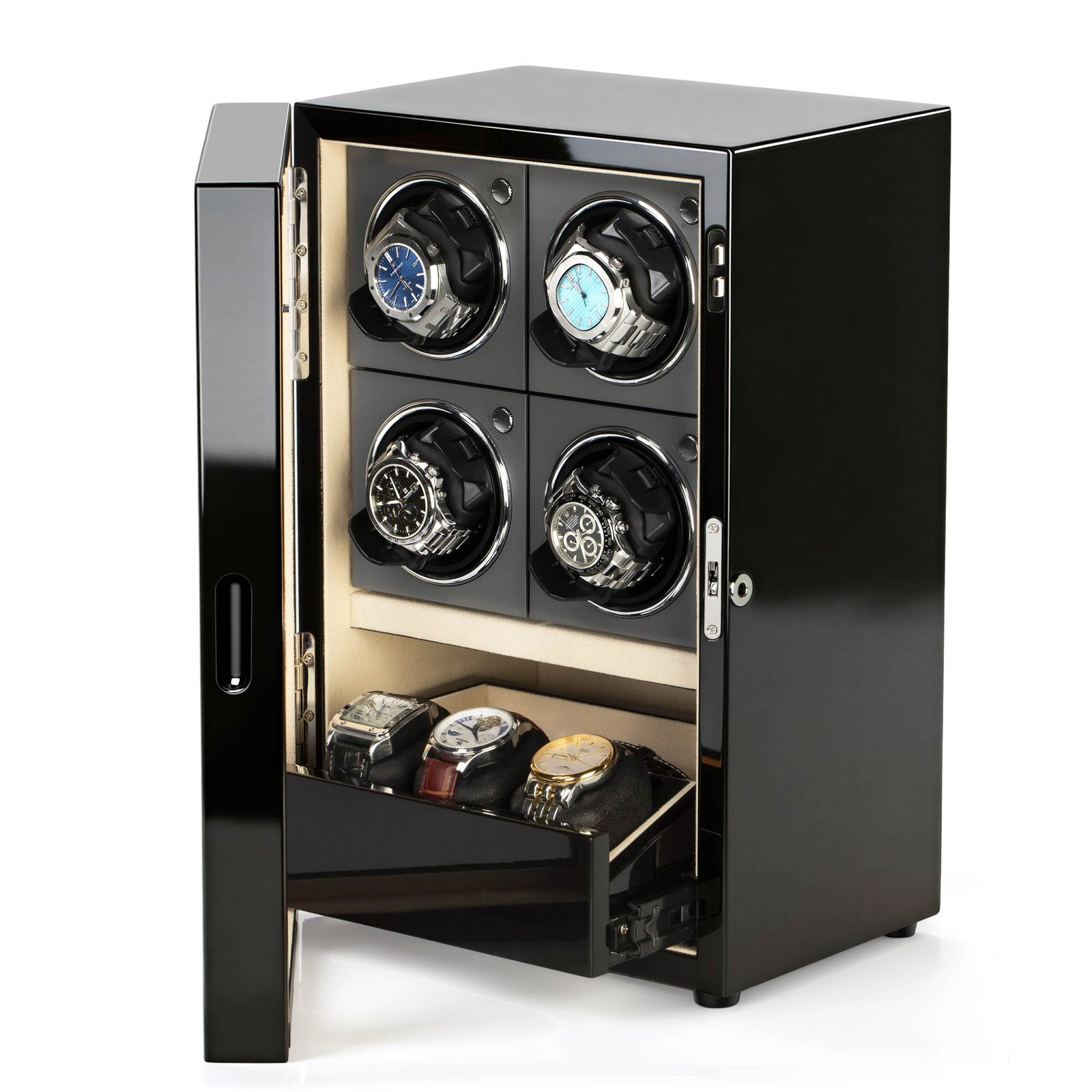
Discover GALOSOM's luxury 4+3 watch winder with removable modules, ultra-quiet brushless motors, customizable front trim panels, and elegant watch storage.