
































































































































































































































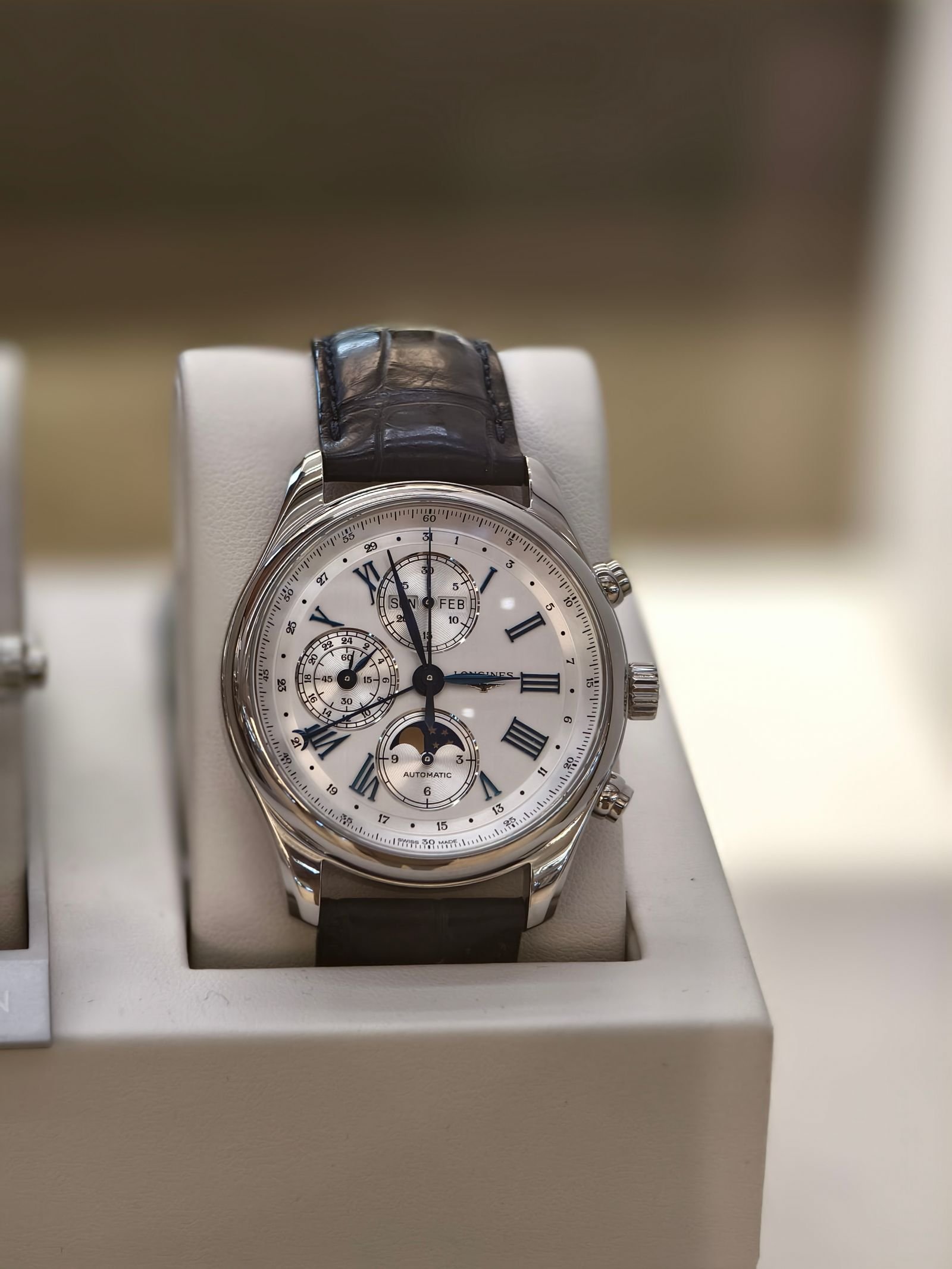
A sensible starting point for Rolex Caliber 4130 winder settings is 650 turns per day (TPD) in bidirectional mode. Give a stopped watch a manual wind first, then test the program for at least three days. If the watch loses reserve, confirm the machine is delivering the setting it claims before raising the TPD in small steps.
That answer is deliberately described as a starting point, not an official Rolex prescription. Rolex published technical specifications for the Caliber 4130, including its automatic winding system and approximately 72-hour power reserve, but it did not publish a consumer watch-winder TPD requirement. Third-party setting tables also disagree: some recommend 650 TPD bidirectionally, while others list a higher clockwise program. The most dependable solution is to begin conservatively and let the watch show whether the program maintains energy.
Quick Rolex Caliber 4130 Winder Settings
- Starting setting: 650 total TPD
- Direction: Bidirectional, if available
- Test period: 72 hours without wearing or manually winding the watch
- Adjustment: Move to 700, 750, or 800 TPD only if reserve declines
- Preparation: Manually wind a stopped watch before the test
- Goal: Maintain useful reserve, not force the mainspring to remain at maximum charge
If a winder offers only 600 or 800 TPD, begin with 600 after a proper manual start. Move to 800 only if the lower program cannot maintain the watch. If the machine offers one-way modes only, follow its documented setting for the 4130 and verify the result with the same reserve test described below.
What Is the Rolex Caliber 4130?
Rolex introduced the manufacture Caliber 4130 in 2000 for the Cosmograph Daytona. It replaced the modified Zenith-based movement used in the preceding generation and consolidated the chronograph mechanism into a more compact architecture. Rolex’s period material describes it as a self-winding mechanical chronograph with a Perpetual rotor and an approximate power reserve of 72 hours.
The movement powered well-known Daytona references including the 116520, 116500LN, and precious-metal variants of that generation. In 2023, Rolex introduced Caliber 4131 for the redesigned Daytona family. That distinction matters when selecting a winder setting: identify the movement by the exact reference and documentation rather than assuming every Daytona contains a 4130.
The 4130 runs at 28,800 vibrations per hour, but that number has no direct relationship to TPD. Beat rate measures the oscillator’s frequency. Turns per day describe how many complete rotations the winder’s holder makes in a 24-hour program. Confusing the two specifications can lead to wildly unsuitable settings.
Why 650 TPD and Bidirectional Is a Practical Baseline
A watch winder does not need to fill an empty 72-hour reserve every day. Its normal job is to replace the energy the movement consumes while the watch is off the wrist. A conservative maintenance program therefore makes more sense than selecting the highest number available.
Multiple specialist sources use 650 TPD as a baseline for Rolex automatic movements, including the 4130, while some tables recommend 800 to 950 TPD or clockwise rotation. Those disagreements are a reason to test, not a reason to panic. Winder manufacturers count turns differently, cushions can slip, and the delivered motion may not precisely match the display. A healthy watch can also respond differently depending on its starting reserve and the condition of its automatic winding system.
Bidirectional mode is the most useful first test because it matches the commonly documented behavior of the Rolex Perpetual winding system and is available on most programmable winders. It also avoids relying on inconsistent labels: some makers define clockwise from the viewer’s perspective, while others describe the holder or rotor direction.
Do not assume that a higher setting makes the watch more accurate. A winder supplies energy; it does not regulate the oscillator. A Daytona that gains or loses excessive time may need testing for rate, amplitude, beat error, magnetism, impact damage, or service condition.

How to Set Up and Test the Winder
- Confirm the movement. Match the case reference to reliable documentation or ask a qualified watchmaker. Do not open the case yourself; correct resealing and pressure testing require proper equipment.
- Inspect the watch first. Stop if the crown feels gritty, the rotor makes a new scraping sound, the watch has visible moisture, or it began misbehaving after an impact. A winder can mask a symptom but cannot repair it.
- Start it by hand. Unscrew the crown and wind it clockwise gently. Rolex user guidance for stopped automatic watches commonly calls for several dozen turns; follow the instructions for your exact reference. Screw the crown down carefully without cross-threading it.
- Mount it securely. The case should remain centered. The bracelet must not slap the cabinet, and the cushion should not put excessive outward pressure on links or clasp.
- Select 650 total TPD and bidirectional rotation. Check whether the display means total daily turns or turns in each direction. A setting of 650 per direction would create 1,300 physical rotations.
- Run the test for 72 hours. Do not wear the watch or add manual wind during the test. Check at the same time each day and note whether it is still running.
- Measure the remaining reserve. Remove the watch from the winder and let it run undisturbed. You do not need a laboratory-perfect 72-hour result, but a very short run time suggests that the program did not build or maintain much reserve.
If the watch remains running and retains a useful reserve after the test, the starting program is doing its job. More turns will not improve the movement simply because the display shows a larger number.
How to Fine-Tune TPD Without Guessing
If the watch stops on 650 TPD, repeat the test after confirming that the winder completed its cycles and the watch did not move on the cushion. Then raise the program by one available step, normally 50 to 150 TPD. Keep direction unchanged so you test only one variable.
At 750 or 800 TPD, run another three-day test. Stop increasing once the watch maintains adequate reserve. Jumping straight to 1,200 or 1,500 TPD may hide a weak automatic system while creating needless motion for both the movement and winder motor.
If a one-way program works but bidirectional mode does not, investigate the winder’s counting method and output before concluding that the movement winds in only one direction. Conversely, if your winder manufacturer maintains a tested database for its own equipment and specifies a different 4130 program, its recommendation may reflect that machine’s cycle design. Use the watch’s reserve as the final check.
Should the Chronograph Run on the Winder?
Leave the chronograph stopped unless you have a specific reason to time something. Running the central seconds and chronograph counters consumes additional energy and changes the test. It also adds operating hours to components that do not need to run while the watch is stored.
This is not a claim that the 4130 chronograph is fragile. The movement was designed for normal chronograph use. The point is methodological: a winder test should measure whether the automatic system maintains the watch under ordinary timekeeping load. Keeping the chronograph engaged introduces an avoidable variable.
When a Winder Makes Sense for a Daytona
The Caliber 4130 has no date display to reset, and its approximately 72-hour reserve can cover much of a weekend. That makes a winder a convenience rather than a necessity. It can still be useful when the Daytona rotates with several other watches, when the owner wants it ready at a predictable state of wind, or when repeated crown handling is inconvenient.
For long-term storage, letting a healthy watch stop is reasonable. Store it clean, dry, and protected from strong magnetic fields, extreme temperatures, and impact. Restart and set it when you plan to wear it. A winder does not preserve lubricants indefinitely, replace routine inspection, or eliminate the need for service.
Signs the Problem Is the Watch, Not the Setting
A Caliber 4130 that still loses reserve at a verified moderate setting deserves a comparison test. Fully wind it according to the correct user guide, leave it stationary with the chronograph stopped, and record how long it runs. Then compare its behavior during a normal active day on the wrist.
Seek professional inspection if the reserve is dramatically shorter than expected, the watch stops in particular positions, the crown or rotor sounds abnormal, or it requires extreme TPD to keep running. Possible causes include reduced winding efficiency, worn automatic-work components, old lubricant, low amplitude, or a fault elsewhere in the movement. Increasing rotations is not a repair.

FAQ
What are the best Rolex Caliber 4130 winder settings?
Start at 650 total TPD in bidirectional mode after manually winding the watch. Test for at least 72 hours and increase in small steps only if reserve declines.
Is 650 TPD an official Rolex specification?
No. Rolex documents the movement and its approximate power reserve but does not publish an official consumer winder TPD value for the 4130. The 650-TPD figure is a practical industry baseline.
Does the Caliber 4130 need clockwise-only rotation?
Some third-party tables say clockwise, while others specify bidirectional operation. Begin with bidirectional mode on a programmable winder, consult the machine maker’s tested database, and verify the result by measuring reserve.
Can a watch winder overwind a Rolex Daytona?
A modern automatic mainspring is designed to slip when sufficiently wound, so normal automatic winding does not tighten it without limit. Excessive TPD still creates unnecessary activity and offers no benefit once the watch maintains reserve.
Should I put a stopped Daytona directly on a winder?
Manually wind it first. A maintenance setting may take a long time to revive an empty movement and can make a suitable program appear inadequate.
Will a higher TPD make the watch run more accurately?
No. TPD affects stored energy, not regulation. Persistent rate problems require diagnosis rather than more winder rotations.
Conclusion
For most healthy Rolex Caliber 4130 watches, 650 TPD in bidirectional mode is a measured place to begin. Start with a manually wound watch, confirm how the machine counts rotations, and run a controlled three-day test. Raise the setting only when evidence shows the watch is losing reserve.
The most useful setting is the lowest one that works reliably. That approach respects the difference between maintaining energy and diagnosing a movement, while avoiding the false precision of treating an unofficial database number as a factory command.
Related Reading
For a closely related setup method, see this Rolex Caliber 3135 winder settings guide. If winding produces an unfamiliar sound, use the automatic watch clicking while winding checklist before increasing the program.