

Watch beat rate is one of those specifications that sounds more revealing than it is. A movement described as 21,600 VPH, 4 Hz, or “high beat” may seem easy to rank, yet frequency alone does not tell you whether a watch will be accurate, durable, or pleasant to own. It describes how quickly the regulating organ oscillates. Everything else depends on how well the movement is designed, manufactured, adjusted, lubricated, and maintained.
This guide translates VPH, BPH, Hz, and “beats per second” into plain language. It also explains why a faster beat can make a seconds hand look smoother and help average out small disturbances, while bringing real costs in energy demand, wear management, and engineering complexity.
What Is Watch Beat Rate?
In a conventional mechanical watch, the balance wheel and hairspring form an oscillator. The hairspring repeatedly accelerates the balance toward its neutral position; momentum carries it past that point, and the cycle reverses. The escapement gives the balance small impulses to keep it moving and releases the gear train in controlled steps.
Beat rate describes the frequency of those oscillations. Brands and movement makers commonly express it in vibrations per hour (VPH), beats per hour (BPH), or hertz (Hz). In watch specifications, VPH and BPH are usually used interchangeably. One “vibration” or “beat” is a single swing in one direction, so one complete back-and-forth oscillation contains two beats.
Hertz counts complete oscillations per second. That makes the conversion straightforward:
- 18,000 VPH = 5 beats per second = 2.5 Hz
- 21,600 VPH = 6 beats per second = 3 Hz
- 28,800 VPH = 8 beats per second = 4 Hz
- 36,000 VPH = 10 beats per second = 5 Hz
To convert VPH to Hz, divide by 7,200. For example, 28,800 ÷ 7,200 = 4 Hz. To find visible seconds-hand steps per second in a typical direct-seconds layout, divide VPH by 3,600. A 28,800 VPH movement normally advances the seconds hand eight times per second.
Why the Seconds Hand Looks Smoother at a Higher Beat Rate
A mechanical seconds hand does not truly sweep continuously. It advances in tiny increments as the escapement unlocks the wheel train. More beats create more increments per second, so each step covers less distance and appears smoother to the eye.
A 21,600 VPH watch typically shows six steps each second, while a 28,800 VPH watch shows eight. At 36,000 VPH, the hand usually makes ten steps per second. The difference is noticeable in a side-by-side close-up, but case design, hand length, dial scale, and viewing distance influence the impression. A long seconds hand makes individual steps easier to see than a short one.
Do not use the sweep alone to identify a movement. Some watches use indirect seconds mechanisms, deadbeat displays, or other constructions that change how the hand behaves. Video frame rates and shutter speeds can also make one hand appear to pause or jump.
Common Mechanical Watch Frequencies

18,000 VPH (2.5 Hz)
This slower rate is strongly associated with vintage movements and some modern designs that prioritize traditional architecture or long running time. The seconds hand makes five steps per second. Low frequency is not a synonym for low quality: excellent regulation and stable construction can produce very good timekeeping. The movement simply has fewer timing events with which to average small disturbances.
21,600 VPH (3 Hz)
Many dependable modern movements use 21,600 VPH. Seiko’s official specifications for the 4R35 and related calibres list 21,600 vibrations per hour, or six vibrations per second. The rate can support sensible power-reserve targets without demanding the energy of a faster oscillator. It is a practical engineering choice, not merely a budget marker.
28,800 VPH (4 Hz)
Four hertz is extremely common in contemporary Swiss mechanical watches. ETA lists its 2824-2 at 28,800 VPH with a typical 42-hour power reserve. This frequency gives eight seconds-hand steps per second and offers a familiar balance of visual smoothness, shock recovery, energy use, and established service practice.
36,000 VPH (5 Hz)
Five-hertz movements are generally called high beat. Grand Seiko specifies its Calibre 9S85 at 36,000 VPH, with a 55-hour power reserve and a stated mean daily rate of +5 to −3 seconds. Zenith’s El Primero 3600 also operates at 5 Hz; in that chronograph, the frequency supports a mechanical display measured in tenths of a second. These examples show that high frequency can serve both ordinary timekeeping and a complication with finer elapsed-time divisions.
Does a Higher Beat Rate Make a Watch More Accurate?
It can create an advantage, but it does not guarantee the result. A faster oscillator experiences more timing events over a given period. In principle, that can average out brief disturbances and reduce the proportional effect of a small error during one beat. A higher-frequency balance may also recover more quickly from some changes in position or motion.
Actual rate performance depends on far more than frequency:
- the geometry and material of the balance spring;
- balance poise and inertia;
- escapement design and manufacturing tolerances;
- mainspring torque and how consistently it reaches the oscillator;
- positional adjustment;
- temperature, magnetism, shock, lubrication, and service condition.
A carefully adjusted 3 Hz movement can outperform a poorly regulated 5 Hz movement. Published frequency should therefore be read as an architectural fact, not an accuracy certificate. Look for a brand’s stated tolerance, independent chronometer certification where applicable, and real measurements over several positions.
The Engineering Trade-Offs Behind High Beat
Increasing frequency asks the movement to do more work. The escapement unlocks more often, the balance reverses direction more frequently, and the movement must deliver enough energy to preserve useful amplitude. Designers may need a stronger mainspring, a more efficient escapement, lighter components, improved materials, or multiple barrels to maintain both frequency and power reserve.
More interactions also make friction and lubrication especially important. That does not mean a properly designed high-beat watch is fragile or destined for a short life. It means its maker must control wear, oil behavior, component mass, and torque with care. Grand Seiko explicitly describes higher rotational speed as a challenge for power reserve and longevity, then points to component design, materials, and manufacturing as the solution in Calibre 9S85.
Frequency is only one side of the energy budget. A modern 5 Hz movement can have a longer reserve than an older 4 Hz calibre because barrel capacity, escapement efficiency, and overall architecture have improved. Comparing two watches by VPH alone ignores most of the design.

Beat Rate and Chronograph Resolution
Frequency places a theoretical limit on the smallest interval an escapement can divide, but the display must be engineered to show that interval honestly. A 5 Hz oscillator produces ten beats per second, which aligns naturally with tenths. Zenith uses that relationship in the El Primero 3600, whose central chronograph hand circles the dial in ten seconds so tenths can be read directly.
That does not mean every 5 Hz chronograph provides a legible or certified one-tenth measurement. The gearing, hand scale, clutch, backlash, and actuation behavior all matter. Likewise, marketing graduations on a dial do not create resolution that the movement cannot support. Readers interested in the architecture behind chronograph engagement can compare vertical and horizontal chronograph clutches; frequency and clutch type solve different problems.
What Beat Rate Means for Power Reserve and Watch Winders
Beat rate does not determine watch-winder settings. A winder replaces energy through the automatic winding system, while frequency describes how quickly the regulating organ oscillates. Two 4 Hz movements can require different rotation directions or turns per day because their winding systems, rotor efficiency, barrels, and intended reserve differ.
Use movement-specific guidance rather than inferring TPD from VPH. Start with the manufacturer’s direction if available and the lowest practical turns-per-day setting that maintains the watch. For a broader setup method, Galosom’s turns-per-day guide explains how to test a winder conservatively. A winder also cannot correct poor amplitude, magnetism, dried lubricant, or a rate problem; those are movement-condition issues.
How to Find Your Watch Movement’s Frequency
- Identify the exact calibre. Model families can change movements across generations, sizes, or references.
- Check the manufacturer’s specifications or manual. Prefer the brand or movement maker over retailer copy.
- Confirm the units. A listing may show VPH, A/h, alternances per hour, BPH, or Hz.
- Cross-check unusual claims. Do not assume “high beat” always means 36,000 VPH, or that a smooth-looking hand proves a particular rate.
A timegrapher can report beat rate, rate error, amplitude, and beat error, but the readings require context. Wrong lift-angle settings can distort amplitude, and a single dial-up result cannot describe performance on the wrist. Treat the tool as diagnostic evidence, not a verdict from one number.
How to Compare Watches Without Overvaluing VPH
For a purchase, consider the complete movement rather than chasing the largest number. Ask how long the reserve lasts, whether the calibre is adjusted in multiple positions, how the brand defines accuracy, and whether competent service is available. Consider thickness, shock resistance, magnetic resistance, complication design, and replacement-part support.
Choose 36,000 VPH if you value the technical achievement, the characteristic seconds motion, or a chronograph display that genuinely uses the frequency. Choose 28,800 or 21,600 VPH without hesitation when the watch better meets your needs. A mature lower-frequency calibre may offer excellent reliability and easier service. The best frequency is the one integrated into a well-executed movement.
Frequently Asked Questions
Is 28,800 VPH considered high beat?
Usage varies, but collectors generally reserve “high beat” for 36,000 VPH or above. At 28,800 VPH, a movement runs at 4 Hz and the seconds hand normally advances eight times per second.
Are VPH and BPH the same?
In modern watch specifications, vibrations per hour and beats per hour normally refer to the same count. Both count each one-way swing of the balance. Always check the manufacturer’s convention if a historical document uses unusual terminology.
Can you hear the difference between 3 Hz and 5 Hz?
Often, yes, in a quiet room. A 5 Hz escapement has a faster tick rhythm than a 3 Hz one. Case construction, water-resistance seals, and the distance from the watch can make the difference less obvious.
Does a high-beat watch need more frequent service?
Not automatically. Follow the maker’s interval and respond to declining accuracy, reserve, or amplitude. Frequency influences the engineering challenge, but materials, lubrication, sealing, use, and movement design determine real service needs.
Does higher VPH mean a shorter power reserve?
All else equal, higher frequency consumes more energy. In real watches, however, barrel capacity and efficiency vary so much that a 5 Hz movement can outlast a 4 Hz movement. Compare the stated reserve of the actual calibres.
Conclusion
Watch beat rate tells you how fast a mechanical movement’s oscillator works: 21,600 VPH is 3 Hz, 28,800 VPH is 4 Hz, and 36,000 VPH is 5 Hz. Higher frequency can produce a smoother-looking seconds hand and provide useful timing resolution, but it is not a shortcut to accuracy or quality. Regulation, energy delivery, materials, adjustment, and maintenance matter just as much. Read VPH as one revealing design choice within a complete movement.
Related Reading
Continue with Galosom’s guide to vertical versus horizontal chronograph clutches, then compare it with Watch Winder Mall’s explanation of column-wheel and cam-operated chronographs.
Collector’s Pick
A practical watch-storage option selected for readers of this guide.
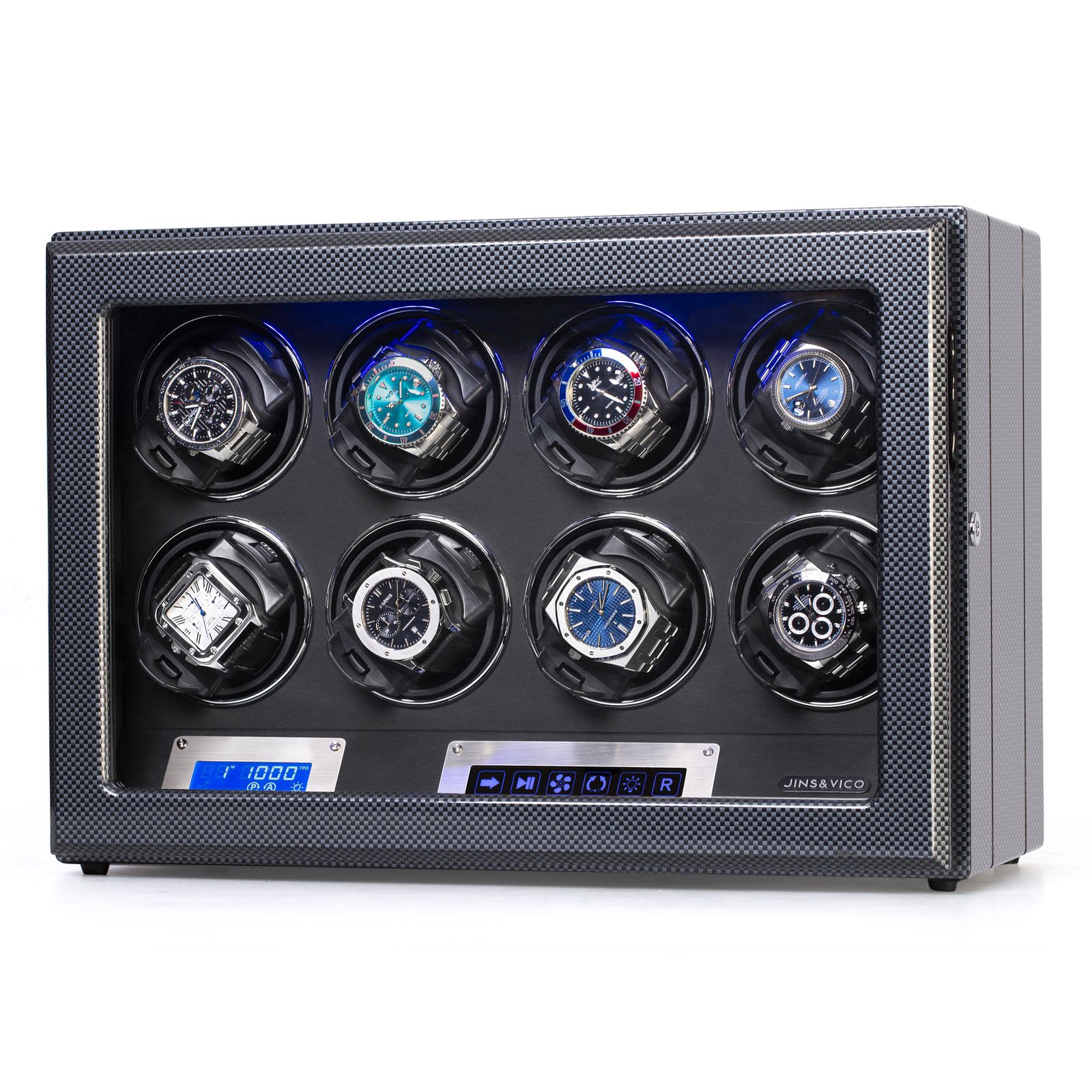
An 8 slot watch winder for automatic watches with high-gloss piano lacquer, LED lighting and lockable case. A best seller for growing collections.