
A loose watch bezel is not always a broken bezel. Many rotating bezels have a small amount of designed clearance, and even a healthy ring may move slightly when pressed from opposite sides. The important distinction is whether the bezel still seats evenly, turns in the intended direction, holds its selected position, and gives consistent feedback around the full circle.
Problems begin when that normal clearance becomes lift, rocking, accidental rotation, missing clicks, or a visible gap. On a dive watch, a bezel that can move too easily may also undermine its purpose as an elapsed-time reference. The movement inside the watch may be perfectly healthy, but the external timing system still deserves attention.
This guide explains how to separate harmless play from a real fault, what commonly loosens a rotating bezel, which checks are safe at home, and why prying or gluing the ring usually creates a more expensive repair.
How Much Bezel Movement Is Normal?
There is no universal amount of acceptable play. Bezel construction, case design, age, service history, and intended use all affect the feel. A slim bidirectional GMT bezel may feel different from a heavily sprung unidirectional dive bezel. Even two examples of the same model can differ slightly after years of wear.
Normal movement is usually small, even, and repeatable. You may feel a trace of side-to-side clearance when pressing gently at 3 and 9 o’clock, but the ring remains parallel to the case. The bezel should not visibly rise, expose a retaining component, or threaten to detach. Its action should remain consistent through a complete rotation.
Backlash is another source of confusion. After a click, some bezels can move a fraction of the distance back toward the previous click. That is not automatically a defect. What matters is whether the zero marker can still be positioned accurately enough for the watch’s purpose and whether the play has increased.
Loose Watch Bezel Warning Signs
Judge the pattern rather than one isolated sensation. A bezel deserves inspection when you notice one or more of the following:
- It rotates during ordinary sleeve contact or while the watch is being worn.
- The ring rocks visibly when pressed at opposite edges.
- One section sits higher than the rest or shows an uneven gap above the case.
- Clicks disappear, double, or feel much softer in part of the rotation.
- The bezel turns in a direction that its manual says should be blocked.
- The zero marker will not stay aligned with the minute hand.
- The bezel began feeling loose immediately after an impact, cleaning, or service.
- A retaining wire, spring, gasket, or other small part appears beneath the edge.
If the bezel lifts far enough to catch a fingernail easily, stop testing it. Continued rotation can deform a spring, scratch the case, damage an insert, or let the entire assembly detach.
Why a Watch Bezel Becomes Loose
A worn or distorted click spring
Many rotating bezels use a shaped spring, wire, pawl, or click component to control direction and indexing. Repeated operation gradually wears contact points. A hard impact or incorrect reassembly can bend the spring and reduce the force that holds each position. The result may be weak clicks, increased reverse play, or rotation in both directions when only one should be possible.
A damaged retaining system
The bezel must be held to the case while still being allowed to rotate. Depending on the watch, retention may rely on a wire, snap fit, retaining ring, screws, or a model-specific clamp. Wear, corrosion, an incomplete snap after service, or a deformed component can allow vertical lift. This is more serious than ordinary rotational backlash because the bezel may no longer be securely attached.
A compressed or missing bezel gasket
Some designs use a gasket beneath the bezel to control friction, spacing, or feel. Age, unsuitable chemicals, incorrect lubrication, or a missing gasket after prior work can make the bezel turn too freely. This bezel gasket is not necessarily the same as the case seals responsible for water resistance, but its absence can still change fit and allow contamination to enter the bezel mechanism.
Wear in the bezel or case seat
A new spring will not cure every loose bezel. If the groove, lip, teeth, or mating surface has worn or been damaged by prying, the bezel itself or a case component may need replacement. Vintage parts can be especially difficult because previous polishing may soften edges and replacement dimensions may vary between references.
Incorrect parts or poor reassembly
A problem that appears directly after insert replacement, refinishing, cleaning, or case work should raise suspicion about fitment. A spring may be upside down, a gasket may be omitted, or an aftermarket bezel may be close in diameter without matching the original retaining geometry. A bezel that snaps on is not necessarily one that is safely retained.

Why Dive-Watch Bezel Security Matters
The bezel on a dive watch is a functional timing device, not merely decoration. ISO 6425:2018 applies to divers’ watches with a secured system for indicating diving time. Seiko and Citizen instructions explain why a conventional dive bezel turns counterclockwise only: an accidental movement should indicate more elapsed time, not less.
If a nominally unidirectional bezel suddenly rotates clockwise, moves without deliberate pressure, or cannot hold the zero marker, do not rely on it for diving. Seiko also warns users not to force a one-way bezel clockwise. A watch can remain water resistant while its timing bezel is faulty; these are separate systems with separate risks.
Professional divers should use appropriate primary instruments and follow training procedures. Citizen describes the watch as an auxiliary reference on relevant dive models. A loose bezel is therefore not a reason to improvise—it is a reason to remove that watch from dive duty until repaired and tested.
Safe Checks You Can Do Without Removing the Bezel
- Confirm the design. Check the exact model manual. Some bezels are unidirectional, others bidirectional, and some use locking mechanisms.
- Work over a clear surface. Use a tray or soft cloth so a loose part cannot disappear. Keep the watch away from water during diagnosis.
- Inspect the gap. Look straight across the case in good light. The bezel should generally sit level, without a single raised section.
- Press gently at four points. Compare 12, 3, 6, and 9 o’clock. Stop if the bezel lifts, clicks vertically, or exposes hardware.
- Rotate one full turn. Use only normal finger pressure and only the permitted direction. Note missing clicks, binding, sudden lightness, or a repeating loose sector.
- Check position retention. Align the zero marker with the minute hand, then wear the watch in a dry, low-risk setting. Unexplained movement suggests insufficient holding force.
- Document the symptom. A short video showing lift, reverse movement, and click behavior can help a seller or watchmaker assess the complaint.
These checks identify behavior; they do not prove which hidden part failed. If the bezel is stiff rather than loose, use the separate guide to a dive watch bezel that is stuck or hard to turn. The cleaning advice for contamination does not apply automatically to a bezel that is lifting or poorly retained.
What Not to Do at Home
Do not pry the bezel off with a knife, screwdriver, razor, or caseback blade. Bezels that appear simple can conceal thin springs and precisely shaped retaining surfaces. A slipping tool can gouge the case, bend the ring, crack a ceramic insert, or send a small component across the room.
Do not use superglue, thread locker, double-sided tape, or adhesive beneath the bezel. Adhesive can freeze a functional timing ring, damage finishes, complicate future service, and conceal rather than restore the retention system. An insert adhesive is also not a substitute for a sound bezel assembly.
Avoid WD-40, household oil, penetrating spray, silicone spray, and random grease. The wrong chemical can migrate, attack adhesives or polymers, trap abrasive dirt, and alter the designed friction. Do not hammer or squeeze the bezel to tighten it, and do not force a unidirectional bezel backward to “test” the spring.
Finally, do not assume that a loose bezel can be fixed by tightening a screw unless the manufacturer’s design actually uses an accessible adjustment screw. Many rings are retained by interference and spring geometry, where improvised tightening only deforms expensive parts.
What a Watchmaker Will Inspect
A proper diagnosis begins by confirming the bezel type and reproducing the symptom. The watchmaker can then remove the bezel with tools that support the case and ring correctly. Under magnification, the inspection may cover the click spring or pawl, retaining wire, gasket, ratchet teeth, bezel groove, insert, case seat, and signs of corrosion or prior tool damage.
Simple repairs may involve cleaning debris and fitting the correct new spring or gasket. More serious damage can require a bezel assembly, retaining ring, or case component. The repairer should verify direction, click count, alignment, rotational force, vertical security, and uniform clearance after reassembly.
If the watch is intended for water use, ask whether the case also needs a water-resistance test. Bezel removal alone does not normally open the movement compartment, but an impact strong enough to loosen the bezel may have affected the crystal, case, crown, or seals. Water resistance should be established by testing, not inferred from appearance.

Should You Wear a Watch With a Loose Bezel?
A tiny, unchanged amount of rotational play on a non-diving watch is usually not an emergency. Monitor it and mention it at the next service. If the bezel lifts, rotates accidentally, catches clothing, changes direction, or sounds as though a loose part is moving underneath, stop wearing the watch until it is inspected.
Do not dive, swim, or use the bezel for safety-critical timing while its retention or indexing is uncertain. Store the watch dial-up in a dry box where the ring cannot snag. If the bezel detaches, collect every component without trying to snap it back on, and place the parts in a labeled bag for the watchmaker.
FAQ
Is a little play in a rotating watch bezel normal?
Often, yes. Small and even rotational backlash or side clearance can be part of the design. Visible lift, an uneven gap, accidental rotation, or a sudden increase in movement is more concerning.
Can a loose bezel make a watch leak?
Not necessarily. The rotating bezel is usually outside the sealed watch case. However, the impact or poor service that loosened it could also affect the crystal, crown, or case seals, so water resistance should not be assumed.
Why does my dive bezel turn both ways?
First confirm the model, because not every rotating bezel is unidirectional. If the manual specifies counterclockwise-only operation and it now turns both ways, the click or anti-reverse mechanism may be worn, bent, missing, or incorrectly assembled.
Can I glue a loose watch bezel back on?
No. Glue can damage finishes and prevent the bezel from working or being serviced. The correct repair restores the model’s retaining spring, gasket, ring, screws, or other designed components.
How much does loose bezel repair cost?
Cost depends on the design and damage. Cleaning or replacing a spring can be modest, while a cracked ceramic insert, discontinued vintage bezel, damaged case seat, or complete branded assembly can be expensive. Ask for diagnosis before approving parts.
Conclusion
A loose watch bezel should be judged by function, not by feel alone. Slight, consistent play can be normal. Lift, uneven seating, weak or missing clicks, unintended reverse rotation, and accidental movement are repair signs. Gentle external checks can document the problem, but prying, forcing, lubricating, or gluing the ring risks turning a small fault into permanent damage.
Until the bezel is secure, treat it as an unreliable timing device. A watchmaker can identify the retaining system, replace the correct worn parts, and confirm that the ring once again rotates, indexes, and stays attached as its maker intended.
Related Reading
For the opposite symptom, read how to handle a dive watch bezel that is stuck or hard to turn. For the sealing system beneath a sports watch’s exterior, see when to replace watch gaskets.
Collector’s Pick
A practical watch-storage option selected for readers of this guide.
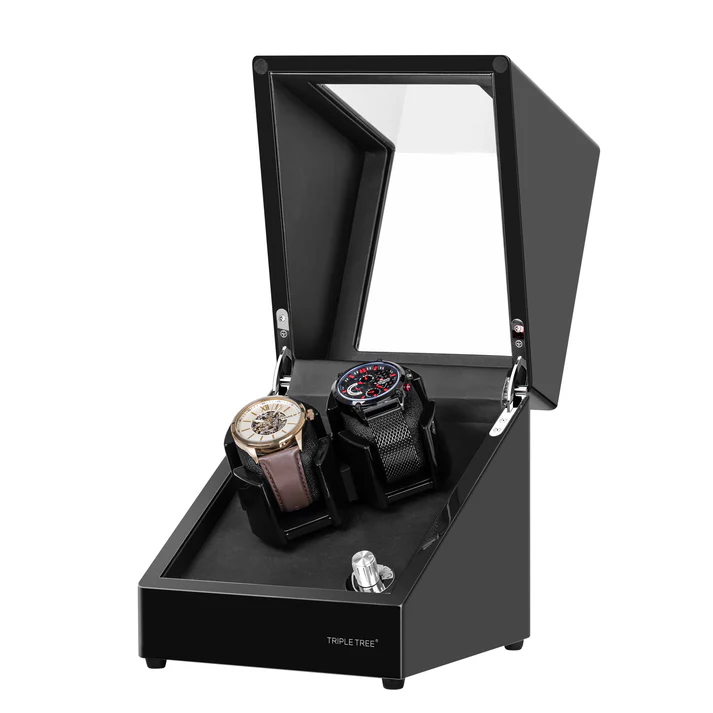
A piano black double watch winder for two automatic watches, with high-gloss lacquer finish, knob control, quiet motor and multiple rotation modes.