
Watch Winding Feels Gritty? Causes, Safe Checks, and When to Stop

A mechanical watch communicates through its crown. Depending on the movement, winding may feel light and nearly silent, firm with distinct clicks, or progressively tighter as a hand-wound mainspring approaches full wind. What it should not feel like is sand moving between metal parts.
If your watch winding feels gritty, stop treating the symptom as a test of strength. The sensation can come from something as simple as debris around a screw-down crown, but it may also indicate damaged threads, a dry seal, corrosion, or wear inside the winding mechanism. Continuing to force the crown can turn a modest service job into a broken stem, crown, or wheel.
This guide explains how to separate normal mechanical feedback from a genuine fault, which checks are safe at home, and what information helps a watchmaker diagnose the problem. It applies to hand-wound and automatic mechanical watches, although their normal full-wind behavior differs.
What Normal Winding Should Feel Like
There is no universal “correct” crown feel. Crown diameter, gasket pressure, case construction, movement design, lubrication, and the number of reduction gears all influence what reaches your fingertips. Two healthy watches can feel completely different.
A typical automatic watch gives repeated, reasonably even clicks or a soft ratcheting sensation while the crown is turned in its winding direction. Resistance may increase slightly, but most automatic movements use a slipping bridle in the mainspring barrel. Once the spring has enough tension, that bridle slips against the barrel wall so wrist motion cannot continually overload the spring. This means an automatic watch generally does not reach the same hard stop as a traditional manually wound watch.
A hand-wound watch often becomes progressively firmer and ultimately reaches a definite stop when fully wound. The exact instruction depends on the caliber, so the manufacturer’s manual takes priority. For example, OMEGA’s manual-wound Speedmaster instructions tell the owner to turn the crown forward until it stops and explicitly warn not to force it. That final firm limit is not the same as random grinding, skipping, or uneven resistance earlier in the wind.
Some sounds are normal too. The click prevents the mainspring from unwinding through the crown, and its engagement can produce an audible tick. Certain automatic winding systems sound coarser than others during manual winding. The key comparison is the watch’s own established behavior: a sudden change matters more than whether another model feels smoother.
- Usually normal: regular clicks, steady resistance, and a repeatable feel on every rotation.
- Potentially abnormal: scraping, crunching, sticking at one point, intermittent slipping, metal-on-metal grinding, or resistance that has recently increased.
- Stop immediately: the crown locks unexpectedly, turns at an angle, pulls away from the case, or requires noticeably more force than usual.
Why Watch Winding Feels Gritty
Dirt around the crown or crown tube
Dust, dried skin residue, salt, and fine grit collect in the narrow gap between the crown and case. On a screw-down crown, contamination can make the first turns feel rough before the crown releases from the tube. It can also interfere when the crown is screwed back in. External debris is one of the less serious explanations, but pushing particles across threads may still damage them.
Dry, damaged, or displaced crown gasket
Crown seals create friction by design. A healthy gasket can make a crown feel firm, especially on a water-resistant sports watch, but the resistance should be smooth. An aging, dry, swollen, or displaced seal can produce a grab-release sensation. Because the gasket is part of the watch’s water-resistance system, this is not a cue to add household lubricant. The correct seal and watchmaking grease must be used, and water resistance should be pressure-tested afterward.
Cross-threading or worn screw-down threads
If roughness occurs mainly while unscrewing or securing the crown, inspect the screw-down action as the likely area. Cross-threading can begin when the crown is pressed toward the case at an angle and turned clockwise before the threads are aligned. Damaged crown or tube threads may feel notchy, may fail to draw the crown evenly toward the case, or may appear to catch and then release.
Do not keep tightening in the hope that the crown will “seat itself.” A screw-down crown protects water resistance only when correctly engaged. Rolex’s care guidance, for example, instructs owners to unscrew the crown completely before winding and then carefully screw it back against the case. Correct alignment matters as much as tightness.
Dry or contaminated keyless works
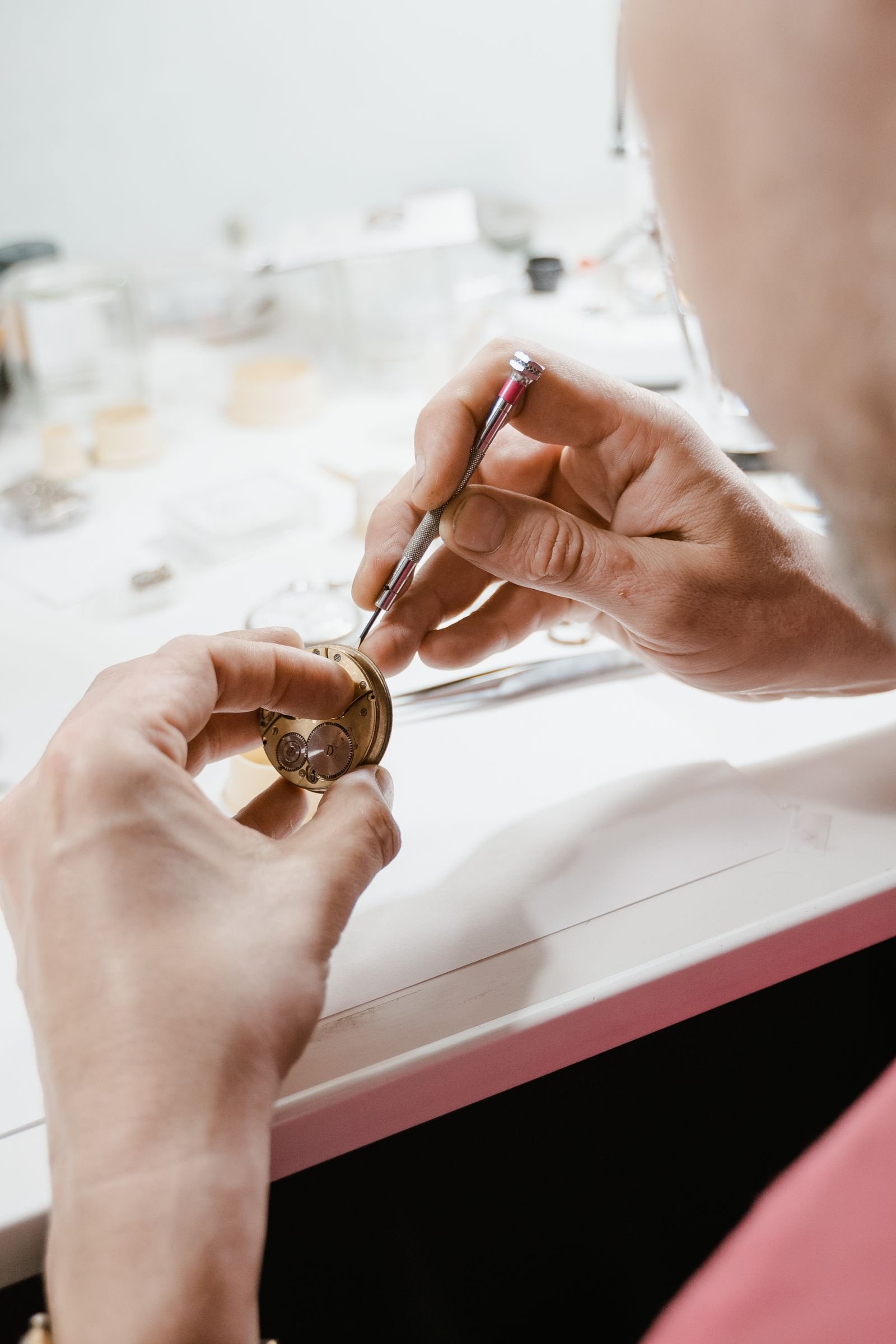
The crown is attached to a stem that operates the keyless works—the levers and wheels that switch between winding, date setting, and hand setting. Old lubricant can thicken or migrate, while contamination or corrosion can increase friction. If the gritty feeling changes when the crown is pulled into different positions, the keyless works or setting mechanism becomes a stronger suspect.
Wear or damage in the winding train
The stem, sliding pinion, winding pinion, intermediate wheels, crown wheel, ratchet wheel, and click must engage cleanly. A chipped tooth, bent stem, loose screw, worn pivot, or incorrectly assembled component can create a repeating rough spot. If the sensation occurs at the same point during each crown turn, a damaged or poorly meshing part is more plausible than general dirt.
Corrosion after moisture entry
Rust can make crown operation rough before a watch shows obvious dial damage. Warning signs include condensation under the crystal, discoloration around the crown tube, a history of swimming with an unsecured crown, or a sudden change after exposure to water. Treat suspected moisture entry as urgent. Leaving the watch to “dry out” does not remove salts or stop corrosion inside the movement.
The movement is fully wound
On a manual-wind movement, rapidly increasing resistance near the expected end of the wind may simply mean the mainspring is fully wound. Stop at the firm limit. On an automatic movement, the bridle normally slips rather than producing a solid stop, though the slipping action can be audible. A gritty feel throughout the winding range is not explained by a full mainspring.
Safe Checks You Can Do Without Opening the Watch
These checks are observational. They do not require removing the caseback, inserting tools around the crown, or applying fluids.
- Take the watch off your wrist. Holding the watch securely reduces sideways force on the stem. Winding while worn can encourage an angled grip, especially with a small crown.
- Confirm the correct crown position. If the watch has a screw-down crown, release it completely before winding. Never try to wind through partially engaged threads.
- Use light fingertip pressure. Turn slowly for only a few rotations. Note whether the roughness is continuous, appears once per revolution, or happens only while screwing the crown in or out.
- Compare functions gently. If the crown pulls normally, observe whether time setting also feels rough. Do not repeatedly cycle a malfunctioning crown. A problem limited to winding points toward a different group of components than roughness in every crown position.
- Inspect externally under good light. Look for visible dirt, a tilted crown, a bent gap, damaged threads, or corrosion. A hand blower may remove loose surface dust. Do not use compressed air, solvents, penetrating oil, or metal picks.
- Record the circumstances. Note when the change began, whether the watch was dropped or wet, how many turns were attempted, and whether it still runs. A short video can preserve the sound for a watchmaker, but do not keep winding solely to make a recording.
It is reasonable to stop after one careful confirmation. Repeatedly reproducing a grinding sensation adds wear without adding much diagnostic value.
What Not to Do
Do not force the crown. Manufacturer instructions commonly emphasize this because the crown provides leverage over very small components. Your fingertips can apply more torque than a damaged tooth or thin stem can tolerate.
Do not drip oil around the crown. General-purpose oils can attack seals, attract debris, migrate into the movement, and complicate later cleaning. Proper watch service uses specific lubricants in controlled amounts at specific contact points.
Do not assume a watch winder will fix it. A winder may keep some automatic watches running without crown winding, but it does not repair the keyless works, threads, seals, or corrosion. Using a winder to avoid a known fault can delay necessary service and may hide a declining power reserve.
Do not rinse a watch with a suspect crown. Even if the model originally carried a strong water-resistance rating, damaged threads or seals can compromise it. Ratings depend on the case being intact and correctly closed.
Do not open the caseback to investigate. Diagnosis often requires movement removal, controlled disassembly, cleaning, lubrication, reassembly, timing, and pressure testing. Opening the case in an uncontrolled environment adds dust and risks scratches or seal damage.
When a Watchmaker Should Inspect It
Arrange an inspection if the roughness is new, persists with light operation, or accompanies any other symptom. Prompt attention is particularly important when:
- the crown binds, skips, spins without winding, or no longer screws down;
- you hear grinding or feel a repeating hard spot;
- the crown or stem looks crooked or has excessive side-to-side play;
- the watch was recently dropped, struck, or exposed to moisture;
- the power reserve has shortened or the watch stops despite winding;
- time or date setting has also become stiff;
- the watch is overdue for service and the crown feel has gradually worsened.
A watchmaker can isolate whether the resistance is outside the case, at the crown and tube, in the keyless works, or farther along the winding train. Depending on the diagnosis, the remedy may be cleaning and lubricating the crown seals, replacing a tube or stem, correcting the keyless works, replacing damaged gears, or performing a complete movement service. If the case has been opened or any seal replaced, request a water-resistance test appropriate to the watch.
Tell the technician whether the roughness happens during winding, unscrewing, date correction, hand setting, or every crown operation. Also disclose water exposure and impacts. These details shorten the path from symptom to cause.
How to Reduce Future Crown and Winding Wear
- Wind the watch off the wrist, using the pads of your fingers and a straight, controlled motion.
- Follow the exact direction and number of turns in the model’s manual.
- On a manual-wind watch, stop when resistance reaches its firm, expected limit.
- On a screw-down crown, align the threads gently before tightening and never use excessive torque.
- Keep the crown secured before water exposure and have water resistance checked periodically.
- Do not postpone inspection when crown feel changes; early intervention may prevent damage to additional parts.
Frequently Asked Questions
Is a slightly rough winding sound normal?
Some movements have an audible ratchet or coarse mechanical character, so sound alone is not enough to diagnose a fault. Consistent feel from new is less concerning than a sudden change, scraping sensation, intermittent binding, or visible crown misalignment.
Why does my automatic watch get harder to wind?
A small change in resistance can be normal, but an automatic movement usually uses a slipping mainspring bridle and should not reach a hard stop like many manual-wind watches. If resistance becomes excessive or gritty, stop and have it inspected.
Can I use silicone grease on a stiff crown?
Do not apply it externally as a guess. Watchmakers use compatible grease on specified seals after inspection, and the amount matters. External application may trap dirt or mask damaged threads, while opening the sealing system calls for a pressure test.
Can grit outside the case get into the movement?
A properly sealed crown is designed to keep contamination out, but worn seals, an open crown, corrosion, or damaged tubes can reduce protection. External grit can also abrade crown and tube threads even if it never reaches the movement.
Will a gritty crown make the watch inaccurate?
Not necessarily. The winding and setting mechanism is separate from the regulating organ, so the watch may initially keep good time. However, poor winding can reduce delivered power, and debris, corrosion, or broader lubrication problems may affect performance. Accuracy is not proof that the crown fault is harmless.
Conclusion
When watch winding feels gritty, the safest response is simple: stop applying force, identify exactly when the sensation occurs, and keep the watch away from water until its crown and seals are known to be sound. Normal movements differ in sound and resistance, but new grinding, sticking, or uneven feedback is not something to wear in through repetition.
A careful external check may reveal dirt or a misaligned screw-down crown, yet internal causes require a trained watchmaker. Early diagnosis protects the crown, stem, winding train, and case sealing—and usually costs less than continuing until a small fault breaks another component.